
Practical Garden Guide
How to Choose a Garden Hose: Length, Diameter, and Material
Start with the route, water demand and storage method, then compare hose construction and fittings around that real job.
By Gardening Is Ezee EditorsUpdated 16 min read
Choose a garden hose by measuring the route it must cover, checking the water demand of the job, and deciding how much weight you can comfortably move. Length, internal diameter, material, fittings, and storage should work together. Buying the longest or heaviest hose available is not a reliable shortcut to a better watering setup.
For occasional watering near a patio, easy handling may matter most. For feeding a sprinkler across a larger yard, the hose's effect on water delivery becomes more important. For filling containers or connecting an irrigation system, compatibility and reliable connections may matter more than a long list of spray accessories.
This guide explains the decisions in the order you can make them at home. It also shows which information to check on a product listing, what to test after delivery, and when the problem is likely to be something other than the hose.
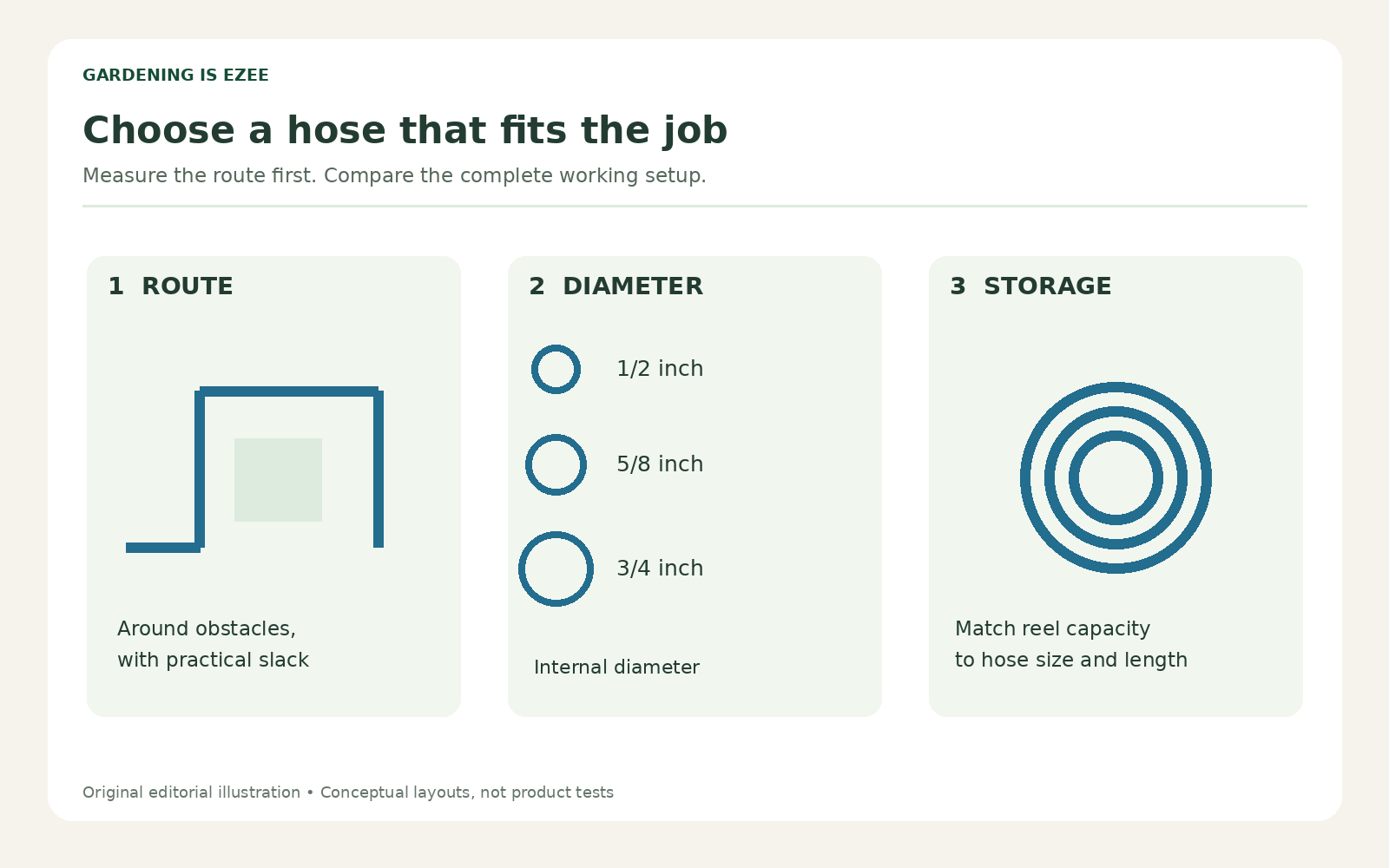
Illustration: Gardening Is Ezee. Diameters are labeled examples, not measured product tests.
Start with the job the hose must do
Write down the main task before looking at products. Hand-watering pots, moving a lawn sprinkler, supplying a pressure washer, and feeding a drip installation are different jobs. The equipment attached to the end may specify inlet conditions, hose size, or operating requirements. Read that manual before choosing the supply hose.
Also note how often you will move it. A hose left in a protected supply route has different handling demands from one dragged around the garden each morning. If you use the same hose for several jobs, identify the most demanding job and the most frequent job. The right compromise should serve both without making the everyday routine frustrating.
Avoid assuming an accessory bundle represents value. A nozzle you will never use does not improve the hose. A mismatched connector or unsuitable reel can turn a seemingly complete kit into a more expensive purchase once you replace parts.
Measure the route, not the straight line
The hose must travel around obstacles. Measure from the faucet along the route you can actually use, including corners, beds, steps, and the last point you need to reach. A straight line across a planted border may be shorter on paper but impossible to use without damaging plants.
Use a tape measure, a known length of rope, or another repeatable measuring method. Add enough slack for comfortable operation and broad bends. Do not stretch the hose tightly against the faucet or rely on pulling it around a sharp corner whenever you need the farthest pot.
Map more than one route if the yard has awkward access. Sometimes a different faucet or a second short hose solves the problem more neatly than a single long run. A hose guide can help at a corner, but it does not compensate for a route that crosses a walkway people need to use.
Choose the shortest practical length
Extra length adds material to carry, store, and drain. It also creates more opportunity for tangles and loops in the working area. Choose a standard length that comfortably covers your measured route rather than buying a hundred-foot hose for a task twenty feet from the faucet.
A longer hose can be useful when the yard genuinely requires it. The point is to have a reason for the length. If only one seasonal task needs a long reach, consider whether an extension used occasionally is more practical than managing the full length every day.
Gilmour's hose selection guide emphasizes matching length to the watering route. Treat its material and product recommendations as a manufacturer's guidance, then compare the exact model specifications with alternatives. Your measured route remains the deciding factor.
Understand what diameter means
Hose diameter normally refers to the internal passage through which water flows, not the outside thickness you see. Common residential product listings include half-inch, five-eighths-inch, and three-quarter-inch options. Do not confuse a nominal fitting description with the internal diameter of the whole hose.
A larger passage can reduce resistance over a comparable run, but actual delivery depends on the entire system. The faucet, supply plumbing, connectors, hose length, elevation, and end attachment all matter. Installing a larger hose will not correct a blocked faucet screen or an unsuitable nozzle.
Compare diameter with the equipment you intend to supply. A product manual may give a minimum inlet flow or hose recommendation. If the application needs sustained flow, look for those requirements first rather than relying on a generic claim that one diameter is best for every household.
Pressure and flow are different questions
Pressure describes the driving force in the water supply. Flow describes how much water moves over time. A narrow nozzle can make a stream feel forceful while delivering less total water than an open hose. That visual impression is not a complete measure of whether a hose suits a sprinkler or irrigation system.
For a simple flow check, use a container with a known volume and record how long it takes to fill under a repeatable setup. Keep the faucet opening and other household water use as consistent as practical. If a one-gallon container fills in fifteen seconds, the measured flow is four gallons per minute under those test conditions.
That calculation is an observation, not a guarantee of future output. Test the actual attachment as well. A hose may fill a bucket quickly but supply a particular device poorly because the device needs different operating conditions.
Rubber, vinyl, hybrid, and fabric-covered designs
Material names provide clues, not a complete ranking. A rubber hose may be appealing for demanding use, but weight and flexibility vary by model. Vinyl products range widely in construction. Hybrid polymers are marketed around handling characteristics, but the term alone does not tell you how a hose behaves in your climate.
Fabric-covered and lightweight designs can be easier to carry. Their abrasion resistance, pressure limits, repairability, and storage instructions still need checking. An outer sleeve does not automatically mean the hose is suitable for dragging across rough concrete or leaving permanently pressurized.
Read the whole specification. Look for the stated operating temperature, pressure conditions, intended use, warranty terms, and handling instructions. Product photographs rarely tell you how easy a hose is to coil when cold or how much it weighs when full. Those are important practical questions to test after delivery.
Expandable hoses need a different evaluation
An expandable hose changes its working size under water pressure. That can make storage convenient, but it means the listed extended length and the empty storage length are different measurements. Confirm which length is being advertised and what supply conditions are required to achieve it.
Check whether your planned attachment is compatible with the design. Some tasks involve frequent pressure changes or an outlet that restricts flow. Follow the hose's instructions for leaving water on, draining, and storing it. Do not assume a product can remain connected and pressurized indefinitely.
An expandable design is worth considering when compact storage genuinely solves a problem. It is less compelling if you need a predictable fixed supply line or want easily replaceable standard repair fittings. Match the design to the routine, not to a dramatic before-and-after photograph.
Weight matters when the hose is full
Empty weight is useful for carrying the hose out of storage, but watering happens with water inside it. Compare the length you actually need rather than comparing a short lightweight hose with a much longer heavy-duty model. A fair handling comparison includes the same working route and task.
Think about stairs, slopes, lifting, and repeated coiling. A hose that is acceptable on a flat lawn may be tiring to carry up steps. If you often work one-handed while holding a watering wand, couplings and the nozzle add to the load at the end.
You can improve handling without changing material. Shorten the route, move storage nearer the faucet, or use a suitable reel. If the setup requires dragging a full hose across the whole property every day, changing the layout may produce a bigger benefit than buying a slightly lighter hose.
Look closely at couplings and washers
A hose connection should match the faucet or accessory, start easily by hand, and seal as designed. Cross-threading can damage a coupling before the first watering session. If the connection resists from the beginning, stop and check alignment and thread compatibility rather than applying more force.
Many standard garden-hose connections seal through a washer. A missing, hardened, damaged, or misaligned washer can cause a leak even when the hose itself is sound. Do not automatically add thread tape to every hose connection; identify how that particular joint is intended to seal.
Large gripping surfaces can make connection easier. Swivel designs may help reduce twisting at an attachment, but inspect their instructions and durability claims. Keep spare compatible washers and record the fitting type. A minor connector problem should not require replacing an otherwise serviceable hose.
Kink resistance is not the same as kink immunity
A hose can fold sharply when pulled around a corner, twisted during storage, or compressed under an object. A kink-resistant claim does not eliminate the need for a sensible route. Marketing language also does not establish how a product performs on your particular surfaces.
When a hose kinks, stop pulling and correct the bend. Dragging harder can move the problem closer to the faucet or damage the outer structure. Uncoil the hose before use and watch for loops that tighten when you walk away with the nozzle.
After purchase, test ordinary handling rather than trying to force a destructive bend. Walk the real route, water the farthest area, and rewind the hose as you normally would. If repeated kinks occur during reasonable use, the design may be a poor match even if the specifications appear suitable.
Check the storage system before buying

A garden hose reel keeps the watering route organized between uses. Photo: Hedwig Storch, CC BY-SA 3.0 via Wikimedia Commons.

A reel's advertised capacity is usually tied to a particular hose diameter or design. A reel rated for one hundred feet of one size may not hold the same length of a thicker hose. Check the compatibility information rather than using length alone.
Allow room for the reel's operating movement. A wall-mounted unit may need clearance to swivel. A portable reel must travel across the same ground as the hose. Confirm that the mounting surface can support the installation and that the supplied hardware is appropriate for it.
If using a hose hanger, choose a shape and position that support broad loops without sharp bends. Keep the faucet accessible for shutoff. Good storage should make the end of watering easy enough that you will actually drain and put the hose away as instructed.
Temperature, sunlight, and surfaces
A hose used in a shaded garden faces different conditions from one left on a hot driveway. Check the stated temperature limits and storage guidance, especially when buying a design intended for cold-weather flexibility or lightweight summer use. Those claims are model-specific.
Consider abrasion along the route. Rough paving, exposed screws, sharp edging, and gravel can wear the outer surface. A premium hose can still be damaged if the installation repeatedly pulls it across an unsuitable edge. Smooth the route or add appropriate guides before upgrading the hose.
Water temperature is another separate issue. A garden hose is not automatically rated for hot water, and a sun-warmed hose can release unpleasantly hot water when first opened. Direct the first flow away from delicate plants and people, then check conditions before watering.
Drinking-water suitability must be explicit
If the hose will carry water for drinking or another potable-water application, look for explicit suitability and relevant certification for the complete product. Color, material appearance, and the presence of brass fittings do not establish that suitability. An ordinary watering hose should not be assumed to meet it.
Check accessories as well. A suitable hose connected through an unsuitable fitting or storage arrangement does not automatically create a suitable potable-water system. Follow the product's cleaning, flushing, and use instructions.
For routine garden watering, buy for the task you have. If you want one hose to serve both garden and potable uses, identify the higher requirement before purchasing. Avoid treating a generic online description such as safe or premium as a substitute for clearly documented intended use.
Three purchase examples
A small patio with ten containers
Measure the faucet-to-pot route and include the far corner. A manageable short hose with a comfortable nozzle may be more useful than an oversized commercial model. Check whether the nozzle can produce gentle watering without requiring a tiring grip.
If daily hand-watering becomes a burden, consider a separate drip installation rather than merely buying a longer hose. The hose may be working perfectly; the time-consuming part is visiting every pot. Choose the equipment that changes the task you want to simplify.
A lawn sprinkler at the back of the yard
The sprinkler's inlet requirements and the length of the run matter. Test available flow, check the sprinkler manual, and choose a suitable diameter for the whole route. Remove unnecessary restrictions such as undersized adapters where the equipment permits it.
If the sprinkler performs poorly, compare it near the faucet before blaming the hose. A simple controlled comparison can help separate supply limitations from losses along the route. Buying another hose without identifying the cause can repeat the same disappointment.
A mixed garden with several watering zones
A dedicated supply route may be easier than moving one hose among beds every day. Think about whether fixed tubing, multiple shorter hoses, or a suitable manifold fits the layout. Keep access for inspection and avoid unsupported loads on the faucet.
Read Soaker Hose vs Drip Irrigation before choosing the downstream system. The supply hose and the watering line serve different roles. Selecting them together prevents a convenient hose from feeding an unsuitable installation.
Test the hose during the return window
Check the model, length, diameter, and included parts when the package arrives. Inspect the couplings and outer surface. Keep packaging and receipts until you have completed an ordinary working test. Do not modify fittings before understanding the return and warranty terms.
Connect by hand, turn on the water gradually, and inspect both ends. Walk the route with the real attachment. Check reach, handling, and storage. Compare any measured flow with your previous setup under similar conditions, recognizing that the source can vary.
Write down specific problems. A clear note such as cannot reach the back pot without tension or repeatedly folds at the patio corner is more useful than simply saying the hose feels wrong. Those observations guide either a replacement choice or an improvement to the route.
Frequently asked questions
Is five-eighths inch always the best diameter?
No. It is a common product size, but the right choice depends on length, source conditions, and the equipment being supplied. A compact watering task may prioritize handling; a longer sustained-flow task may need a different evaluation. Use the attachment's requirements and the actual route.
Can I connect two hoses together?
Often yes with compatible fittings, but the extra length and connection affect handling and delivery. Inspect the joint for leaks and avoid leaving it where it will be crushed or create a trip point. Compare the resulting setup with the equipment's inlet requirements.
Will a new hose fix low water pressure?
Only if the existing hose or its connections are responsible for the limitation. Test the source, attachment, and route separately. A closed valve, blockage, supply issue, or unsuitable downstream device will not necessarily improve when you replace the hose.
Should I leave the faucet turned on?
Follow the hose and accessory instructions. A timer-controlled installation may have specific requirements, while a hand-watering setup should be shut off and relieved of pressure as directed. Do not assume every hose can remain under continuous pressure just because an end nozzle is closed.
A practical final checklist
Before ordering, confirm the measured route, working length, internal diameter, material, filled handling demands, coupling compatibility, attachment requirements, storage arrangement, and intended temperature conditions. If any listing leaves a key specification unclear, ask the manufacturer before buying.
For nozzle options, see Gardening Is Ezee's watering department and its Melnor hose nozzle guide. Choose a hose that makes the entire setup manageable. The most useful purchase is the one that reaches comfortably, supplies the job adequately, connects reliably, and is easy to put away.
Build a shortlist with specifications you can actually compare
A useful shortlist has three or four candidates that meet the measured route and equipment requirements. Put length, internal diameter, intended use, empty weight, working conditions, coupling type, and storage guidance in separate columns. Mark missing information explicitly. Do not let an attractive photograph fill a blank specification in your mind.
Compare equivalent lengths where possible. A fifty-foot lightweight hose and a one-hundred-foot reinforced hose may have different weights largely because one is twice as long. Likewise, a narrow hose and a wider hose can differ in handling and delivery. Explain the difference rather than turning every number into a ranking.
Read warranty terms as a set of conditions, not merely a number of years. Check what use is covered, whether proof of purchase is required, and how a claim is made. A long warranty can be useful, but it does not tell you how quickly a replacement arrives or whether the product fits your particular task.
Check availability of replacement couplings or repair guidance. Some designs use ordinary fittings; others are not meant to be repaired with a standard hose kit. Repairability can matter if the hose will see frequent use, but attempting an incompatible repair can create leaks and invalidate useful support.
When information is unclear, ask a specific question. Is the listed diameter internal? What is the weight of this length? Is continuous pressure permitted? Does this model work with the planned attachment? A precise answer makes the purchase more reviewable than a vague reassurance that the product is heavy duty.
Reduce the work of watering before upgrading the hose
Sometimes the hose feels inconvenient because the routine is inconvenient. You retrieve it from a shed, carry it past furniture, connect an awkward fitting, pull it around a corner, and then reverse the process. Changing the storage position or route may save more effort than changing the hose material.
Walk the routine from beginning to end. Note every point where you lift, drag, reconnect, or untangle. Can the reel move nearer the faucet? Can pots be grouped without harming their light conditions? Can a permanent supply route serve a distant bed so the everyday hose remains short? These layout questions make equipment decisions more purposeful.
Do not solve one problem by creating another. A reel beside the faucet should not block the shutoff. A shorter route should not pull water across an electrical setup or a busy walkway. A fixed hose should not be placed where it will be crushed during ordinary garden work. Inspect the real route with the same care you give the product listing.
A detachable watering wand can be useful when reach at the plant matters, while a longer supply hose may be necessary when reach across the property matters. Those are different kinds of reach. Buying extra hose length does not make a short nozzle easier to use for a hanging basket.
Review the end attachment's handling too. A stiff trigger or heavy nozzle can make a light hose feel tiring. A comfortable shutoff and suitable spray pattern may improve the routine without replacing the supply hose. Try to locate the source of discomfort rather than assuming the largest component is responsible.
Keep a small maintenance routine at the storage point: inspect the washer, shut off the source, relieve pressure as directed, and store the hose without sharp folds. This is easier when the equipment has a sensible home. A purchase that encourages a manageable routine is more valuable than one that performs well but is unpleasant to put away.
Sources and further reading
- Gilmour: How to Choose a Garden Hose — manufacturer guidance on hose selection.
- Gilmour: Flexogen Super Duty Hose — example of model-specific size information.
- Dramm: ColorStorm Professional Rubber Hose — example of a manufacturer product reference.
Editorial method: This guide provides original selection advice and illustrative calculations. Manufacturer references describe their own products, not independent comparative testing. Gardening Is Ezee has not tested the hoses discussed here.