
Practical Garden Guide
How Much Soil Do You Need for a Raised Bed?
Measure the usable interior, calculate volume in one unit and separate planting mix from mulch before ordering.
By Gardening Is Ezee EditorsUpdated 16 min read
For a rectangular raised bed, multiply the internal length, internal width, and intended fill depth using the same units. Measurements in feet give cubic feet. Divide that result by twenty-seven for cubic yards. Then divide the required volume by the volume printed on each bag and round up to a whole bag.
A four-by-eight-foot bed filled to twelve inches needs thirty-two cubic feet, or about 1.19 cubic yards, before any allowance for settling or a separate mulch layer. If each bag contains two cubic feet, the calculated quantity is sixteen bags. Those numbers describe a simple rectangular space; outside dimensions, rounded corners, liners, and internal braces can change the actual requirement.
This guide shows the calculations, provides checked examples, and explains how to turn a volume estimate into a sensible soil order without confusing compost, topsoil, and container mix.
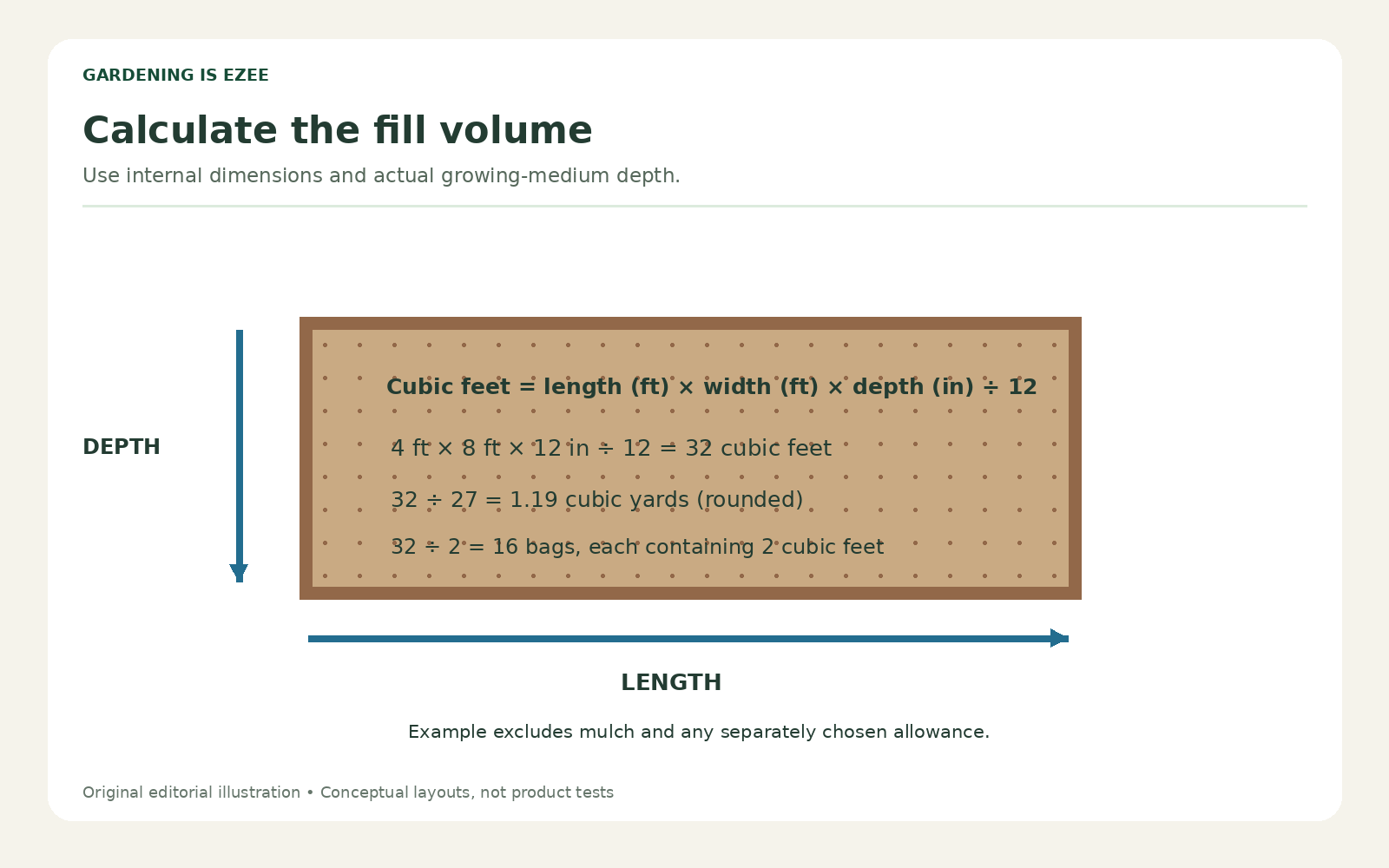
Illustration: Gardening Is Ezee. Measure the inside space and the planned soil surface, not the outside frame.
The three measurements you need

A filled raised bed illustrates why internal dimensions and actual fill depth matter. Photo: peganum from Small Dole, England, CC BY-SA 2.0 via Wikimedia Commons.

Measure internal length from inside wall to inside wall. Measure width the same way. Then decide the growing-medium depth you will actually fill. If the bed wall is sixteen inches high but you plan to leave two inches for watering space and mulch, use fourteen inches for the soil calculation.
For an elevated planter, measure from the planting floor rather than from the ground beneath its legs. For a bottomed design, check whether a reservoir, false floor, or drainage layer specified by the manufacturer occupies some of the space. The total outside height is rarely the correct fill measurement.
Write the units beside every number. Most calculation errors are simple unit errors: length in feet multiplied by depth in inches, or liters treated as gallons. Converting all three measurements before multiplying makes the arithmetic easy to check.
Formula using feet and inches
If length and width are in feet and depth is in inches, divide depth by twelve first. The formula becomes:
Cubic feet = length in feet × width in feet × depth in inches ÷ 12.
For a four-by-eight-foot bed at nine inches: four multiplied by eight multiplied by nine divided by twelve equals twenty-four cubic feet. For the same bed at eighteen inches: four multiplied by eight multiplied by eighteen divided by twelve equals forty-eight cubic feet.
Keep the unrounded result until you convert to a purchase quantity. Rounding too early can produce a shortage across several beds. The final bag count must be a whole number, but intermediate calculations can retain decimals.
Convert cubic feet to cubic yards
One cubic yard is three feet by three feet by three feet, which equals twenty-seven cubic feet. Divide cubic feet by twenty-seven to obtain cubic yards. Do not divide by three; that changes one dimension, not all three dimensions of the volume.
A thirty-two-cubic-foot requirement is thirty-two divided by twenty-seven, or approximately 1.185 cubic yards. A supplier might sell in half-yard or full-yard increments, or allow another quantity. Ask about their ordering units before deciding what to buy.
The mathematical requirement and the order quantity may differ. You may choose a modest documented allowance for settling, or the supplier may have a minimum delivery. Record the reason for any extra volume rather than quietly adding an unexplained percentage.
A checked table for common rectangular beds
The following table uses internal dimensions and actual fill depth. It excludes separate mulch and any settling allowance.
| Internal dimensions | Fill depth | Cubic feet | Cubic yards | Two-cubic-foot bags |
|---|---|---|---|---|
| 2 × 4 feet | 6 inches | 4 | 0.15 | 2 |
| 2 × 4 feet | 12 inches | 8 | 0.30 | 4 |
| 3 × 6 feet | 6 inches | 9 | 0.33 | 5 |
| 3 × 6 feet | 12 inches | 18 | 0.67 | 9 |
| 4 × 4 feet | 6 inches | 8 | 0.30 | 4 |
| 4 × 4 feet | 12 inches | 16 | 0.59 | 8 |
| 4 × 8 feet | 6 inches | 16 | 0.59 | 8 |
| 4 × 8 feet | 9 inches | 24 | 0.89 | 12 |
| 4 × 8 feet | 12 inches | 32 | 1.19 | 16 |
| 4 × 8 feet | 18 inches | 48 | 1.78 | 24 |
| 4 × 8 feet | 24 inches | 64 | 2.37 | 32 |
The five-bag result for the three-by-six-foot bed at six inches includes one cubic foot more than the nine-cubic-foot calculation because bags are indivisible. That difference is purchase rounding, not a recommended settling allowance.
Calculate the number of bags
Use the net volume on the bag, not the bag's weight or physical size. Divide required cubic feet by cubic feet per bag. Round upward once at the end. If you need thirty-two cubic feet and bags contain 1.5 cubic feet each, thirty-two divided by 1.5 is about 21.33, so you need twenty-two bags.
If bags contain one cubic foot, the same bed takes thirty-two bags. If they contain two cubic feet, it takes sixteen. Comparing bag prices without accounting for bag volume can make a smaller bag appear cheaper when its unit cost is higher.
Calculate price per cubic foot by dividing bag price by bag volume. For a hypothetical six-dollar, two-cubic-foot bag, the unit price is three dollars per cubic foot. Use actual prices at purchase time; examples in this guide are arithmetic demonstrations, not current market quotations.
Metric calculations
For measurements in meters, multiply internal length, width, and fill depth to get cubic meters. Multiply cubic meters by one thousand for liters. A bed 1.2 meters long, 2.4 meters wide, and 0.3 meters deep contains 0.864 cubic meters, or 864 liters.
If the bags contain forty liters each, 864 divided by forty equals 21.6, so the purchase quantity is twenty-two bags. The extra sixteen liters comes from rounding to whole bags. Keep the dimensions and bag units consistent throughout the calculation.
For measurements in centimeters, multiply length, width, and depth, then divide by one thousand for liters. For example, one hundred centimeters by two hundred centimeters by thirty centimeters equals six hundred thousand cubic centimeters, which is six hundred liters.
Circular, triangular, and irregular beds
For a circular bed, volume equals pi multiplied by the radius squared multiplied by fill depth. Use the internal radius, not the diameter. A circular bed with a four-foot internal diameter has a two-foot radius. At one foot of fill depth, its volume is about 12.57 cubic feet.
For a triangular bed, find the triangular footprint area by multiplying its base by its perpendicular height and dividing by two. Multiply that area by fill depth. The height of the triangle is a footprint measurement, not the vertical depth of soil.
For an irregular bed, divide the footprint into simple shapes, calculate their areas, and add them before multiplying by depth. Do not count overlapping areas twice. If the walls taper or the depth varies, use an appropriate geometric calculation or request the manufacturer's stated fill volume.
Tapered planters need special care
A planter narrower at the bottom than the top does not have the volume of a rectangle using its largest dimensions. Multiplying top length, top width, and depth can overestimate the fill. Decorative legs and outer cladding can make the error even larger.
Look for a usable soil-volume specification from the manufacturer. Check whether that volume includes a water reservoir or empty structural space. If no specification is available, ask for internal measurements or calculate the appropriate tapered shape rather than pretending it is a box.
For a small planter, a conservative estimate may be manageable because you can store a little spare mix. For a large order, clarify the shape first. An inaccurate estimate across ten planters can become a significant expense and leave a large pile of unwanted material.
Account for existing soil correctly
If a bed already contains usable material, measure the depth you need to add rather than calculating the whole frame. Take several readings because the surface may be uneven. Level lightly as appropriate before deciding how much top-up is required.
A four-by-eight-foot bed needing three additional inches requires eight cubic feet: four multiplied by eight multiplied by three divided by twelve. That is four two-cubic-foot bags before any separately justified allowance.
Do not count unsuitable or contaminated material as usable simply to reduce the order. If the existing fill needs replacement, the volume calculation and the removal plan are separate tasks. Identify the quality issue before layering new material over it.
Soil, compost, and potting mix are different purchases
The word soil on a shopping list can hide several products. Topsoil is not the same as compost, and a container mix is not necessarily the same as a blend designed for an open-bottom raised bed. Read ingredient and intended-use information.
University of Maryland Extension's raised-bed vegetable guidance discusses the growing medium as well as the structure. Use a suitable horticultural reference to choose the blend, then calculate its components. Do not let the volume calculation decide the recipe.
For an elevated planter with a bottom, review container-growing recommendations and the planter manufacturer's instructions. A heavy soil blend appropriate for a ground-connected bed may be a poor choice for a raised container. Choosing the right material matters more than ordering an exact amount of the wrong material.
Calculate a blend by volume
Suppose a supplier-approved blend for your particular bed calls for three components in proportions of fifty, thirty, and twenty percent by volume. For a forty-cubic-foot total, those amounts are twenty, twelve, and eight cubic feet. The percentages should add to one hundred before you place the order.
These numbers are an arithmetic example, not a universal growing-medium recipe. Ingredient suitability, maturity, nutrient content, and physical behavior need separate evaluation. Do not copy the example proportions simply because they are convenient to calculate.
Ask how the supplier measures the blend. A recipe expressed by weight is not interchangeable with one expressed by volume because materials have different densities. Record the units on the order and avoid converting between them without reliable density information.
Settling: allow thoughtfully, not automatically
Freshly filled beds can change in level as materials settle and organic components break down. The amount varies with the blend, handling, and time. A fixed extra percentage is a budgeting choice, not a physical law that applies to every bed.
You can calculate a chosen allowance explicitly. A ten-percent allowance on thirty-two cubic feet adds 3.2 cubic feet for a total of 35.2. That would require eighteen two-cubic-foot bags after rounding. Whether ten percent is appropriate should come from the supplier's guidance and your situation.
Keep space for future top-ups without overfilling the frame. It may be easier to add suitable material later than to dispose of a large surplus today. Ask whether the supplier recommends filling, lightly watering, allowing settling, and checking the level before planting.
Separate mulch from soil volume
If you want a mulch layer, calculate it separately. A four-by-eight-foot bed with a two-inch mulch layer needs about 5.33 cubic feet of mulch: four multiplied by eight multiplied by two divided by twelve. That space should not also be counted as growing medium.
The appropriate mulch material and depth depend on the crop and conditions. The calculation only measures the layer you choose. Keep mulch away from places where it would interfere with planting, irrigation access, or the particular crop's care.
Make the final fill plan visible: growing medium to one level, mulch above it, and any remaining watering space. This prevents a common mistake in which you buy soil for the whole frame and then discover there is no room for the mulch you intended to add.
Bags versus bulk delivery
Bagged material can be convenient for small volumes, restricted access, and gradual filling. You can carry only what you need to the bed, and the packaging provides a clear nominal volume. The trade-offs include repeated lifting, packaging waste, and potentially higher unit cost.
Bulk material can make sense for larger orders if access and quality are suitable. Include delivery fees, minimum quantities, and the work of moving it from the drop point to the garden. A lower price per cubic yard is not necessarily cheaper overall if delivery and handling are expensive.
Ask for a sample or clear product information when ordering bulk material. Identify its ingredients, intended use, and source. The visual appearance of a dark pile does not establish nutrient suitability or freedom from unwanted debris.
Delivery access and staging
Measure gates and paths before arranging delivery. Decide where the material can be placed without blocking access, damaging a surface, or creating drainage problems. If you use a wheelbarrow or cart, check the route and the bed's loading height.
Plan how many trips the volume represents. A hypothetical cart carrying two cubic feet per practical load would need sixteen loads to move thirty-two cubic feet. Actual safe loads depend on material weight, terrain, and your ability, so do not use the volume alone as a lifting recommendation.
Keep the material covered or contained as appropriate while waiting to fill. Avoid leaving soil where runoff can carry it into a drain. A little preparation at the drop point can make a large order much easier to manage.
Two complete purchasing examples
One new four-by-eight-foot bed
The internal footprint is four by eight feet. The wall is fourteen inches high, and the intended growing-medium surface is twelve inches above the base. The calculated growing-medium volume is thirty-two cubic feet.
For two-cubic-foot bags, buy sixteen bags if no additional allowance is chosen. For 1.5-cubic-foot bags, buy twenty-two. For bulk delivery, the calculated requirement is about 1.19 cubic yards; confirm the supplier's available order increments and settling guidance before selecting the final quantity.
Three existing beds needing a top-up
Each internal bed is three by six feet, and each needs two inches of suitable material. One bed needs three cubic feet. Three beds need nine cubic feet total.
With two-cubic-foot bags, five bags provide ten cubic feet. You would not calculate the entire bed depth because the existing material remains in place. This example shows why a top-up measurement can save a substantial unnecessary purchase.
Common mistakes to avoid
Do not multiply feet by inches without conversion. Do not use outside dimensions when the walls take up space. Do not confuse cubic feet with square feet, because a footprint area does not include depth. Do not use bag weight as a volume unless the supplier provides reliable conversion information.
Do not treat a tall planter's leg height as fill depth. Do not calculate a rounded or tapered planter using its largest outside rectangle without acknowledging the error. Do not include a separate mulch layer twice.
Finally, do not buy the cheapest dark material merely because the arithmetic is correct. The estimate tells you how much space to fill. It does not determine whether the material is appropriate for vegetables, containers, or a particular soil condition.
Frequently asked questions
How much soil fills a four-by-eight bed twelve inches deep?
Thirty-two cubic feet, approximately 1.19 cubic yards, before any separately chosen allowance. That equals sixteen two-cubic-foot bags. The calculation assumes internal rectangular dimensions and an actual twelve-inch fill depth.
Should I order extra?
Possibly, based on supplier guidance, settling expectations, and whether spare material is useful. Calculate the allowance separately so you know why the order exceeds the geometric volume. Whole-bag rounding may already provide some extra.
Can I use the same calculation for compost?
Yes, if you are calculating a defined compost layer or component by volume. That does not mean compost should fill the entire bed. Choose the horticultural application first, then calculate the required volume.
How do I calculate a shallow top-up?
Multiply internal length by internal width by the additional depth, with consistent units. Measure several locations to estimate the average addition needed. You do not need to order the full original bed volume if the existing growing medium is suitable.
Build an order sheet before contacting the supplier
List each bed separately with internal length, width, intended fill depth, calculated volume, and the material required. If some beds need only a top-up, keep them separate from new beds. Summing unlike tasks without explaining them makes it easy to order the wrong blend or duplicate an allowance.
Use a second column for additions beyond the geometric estimate. Whole-bag rounding, a supplier-recommended settling allowance, and a delivery minimum are different reasons for extra material. Show each one explicitly. You can then review whether the final order is sensible rather than accepting a larger number without knowing why it changed.
For a mixed order, confirm that each component is measured in the same unit. A supplier may quote topsoil by cubic yard and bagged amendments by cubic foot. Convert before calculating proportions. Do not compare a weight-based price with a volume-based price unless you have reliable density information for the actual material.
Include delivery and handling in the cost sheet. Record the drop location, access constraints, minimum order, delivery fee, and expected way to move the material. If the supplier provides only a rough estimate of volume, clarify what will be delivered and how the order is measured.
Ask for written confirmation of the blend and quantity. A phrase such as garden soil may describe several products. The confirmation should identify the intended use and composition as clearly as the supplier can provide. This is especially valuable when you are ordering a large amount or filling several beds.
Check the estimate against the physical bed
Before filling, verify the dimensions one more time. Assembly can change the internal space from what you assumed in the listing. Braces, tapered walls, or a planting floor may reduce volume. Correcting the estimate before opening every bag is easier than managing an unexpected surplus afterward.
Mark the intended fill line temporarily if the design allows it. A visible reference prevents filling different parts of a long bed to inconsistent levels. Keep any separate mulch layer in mind. The soil surface should follow the horticultural and structural plan, not simply rise until the frame looks full.
When using several bags, count what you add and compare with the estimate. A discrepancy can come from settling, imprecise bag volume, internal geometry, or a measurement error. Do not immediately assume the supplier shorted the order. Review the assumptions before drawing that conclusion.
For bulk fill, avoid compacting the growing medium aggressively just to make it match a calculated volume. The estimate measures space, while the growing medium needs suitable physical condition. Follow reliable filling guidance and let the chosen method determine how you level and settle it.
If material remains, identify a suitable storage or garden use before spreading it everywhere. Extra compost should not automatically go onto every bed regardless of nutrient conditions. Extra container mix should not be treated as the same material as topsoil. Keep the product identity and intended use attached to the surplus.
After the first settling period, measure the remaining free space and record it. That gives you a useful basis for future top-ups. A maintenance order next year should begin with the actual additional depth needed, not the original frame volume or a habit of buying the same number of bags.
A multi-bed arithmetic check
Suppose you have one new four-by-eight-foot bed at twelve inches of fill and two existing three-by-six-foot beds needing two inches each. The new bed requires thirty-two cubic feet. Each top-up requires three cubic feet, so the combined geometric requirement is thirty-eight cubic feet.
With two-cubic-foot bags, that is nineteen bags before any separate allowance. If the new bed and existing beds require different materials, calculate their purchases separately even though the total volume is simple. An order sheet should preserve the distinction between how much space exists and which material belongs in that space.
Related guides and sources
Read How Deep Should a Raised Garden Bed Be? before choosing fill depth, and Drip Irrigation for Raised Beds before finalizing the layout.
- University of Maryland Extension: Growing Vegetables in Raised Beds.
- Oregon State University Extension: Raised Bed Gardening.
- University of New Hampshire Extension: Soil for Potted Plants.
Editorial method: All volume and bag examples are original calculations using the stated dimensions. Prices and percentages are hypothetical illustrations, not quotations or universal soil recipes. No hands-on product testing is claimed.