
Practical Garden Guide
Leaf Blower CFM vs MPH: What Matters for Your Yard?
CFM describes air volume and MPH describes speed; neither number alone captures how a blower will move your particular debris.
By Gardening Is Ezee EditorsUpdated 16 min read
CFM describes the volume of air a leaf blower moves per minute. MPH describes air speed. Both help describe performance, but neither number alone tells you how easily a blower will clear your yard. Compare where the measurements were taken, the nozzle and operating mode used, and the practical demands of the job.
For loose dry leaves over a broad area, moving enough air across the working zone matters. For material that is harder to dislodge, air speed and the complete airflow pattern matter too. The useful choice combines adequate performance with manageable weight, suitable runtime, clear controls, and an operating routine that fits your property.
This guide explains the numbers without turning them into a misleading product ranking. It also shows why a high advertised peak can be less useful than a well-documented working specification and a battery setup that lasts through your normal cleanup.
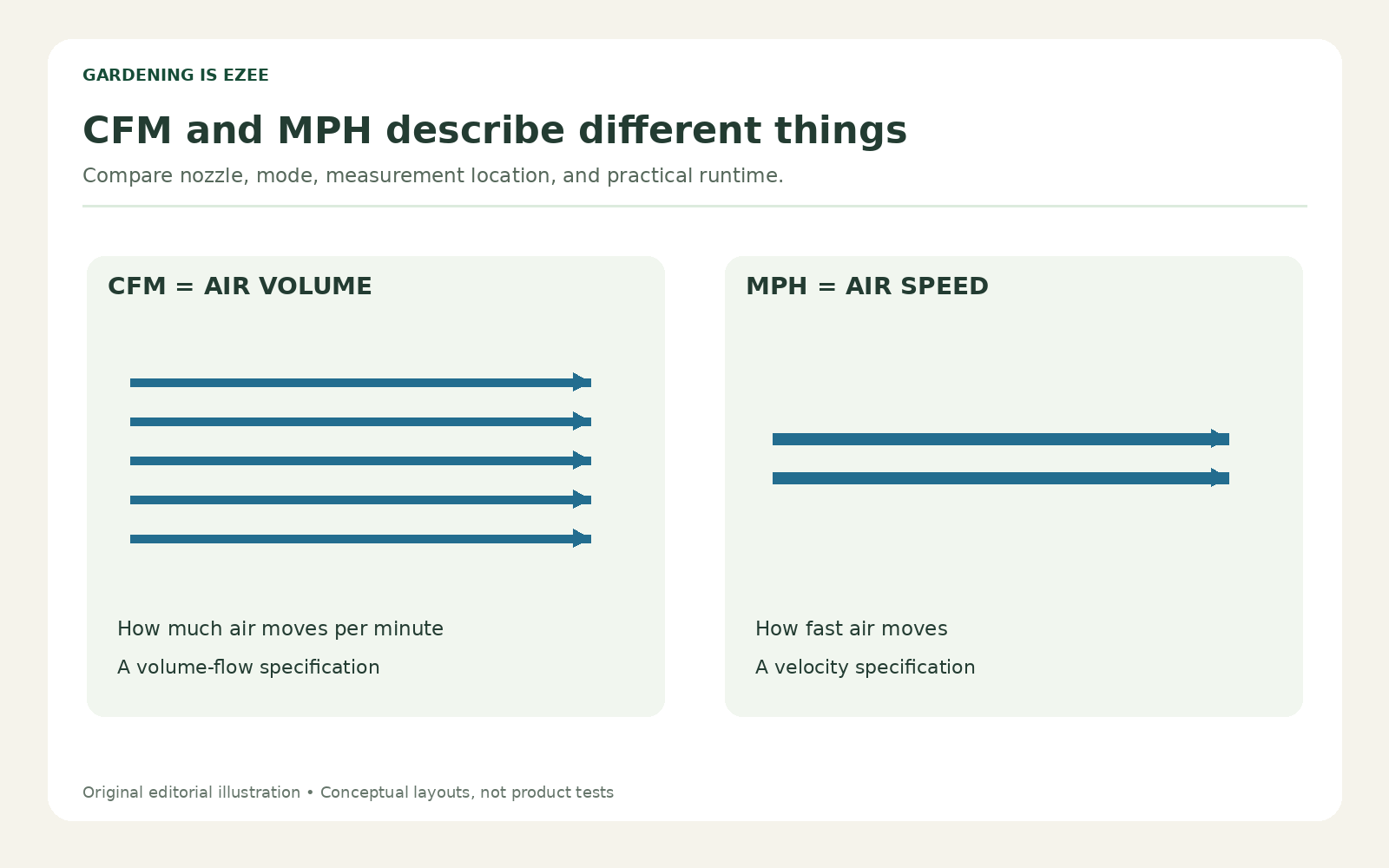
Illustration: Gardening Is Ezee. Airflow drawings are conceptual and do not represent tested blower performance.
What CFM tells you

Leaf blowers in use during a cleanup show the importance of operating position and collection planning. Photo: Peter Dutton, CC BY 2.0 via Wikimedia Commons.

CFM stands for cubic feet per minute. It is a volume-flow measurement: how much air passes a measurement point in a given time. A larger number describes more airflow under the conditions used for that specification.
Those conditions matter. A listing may give airflow at the fan housing, in the tube, or at the nozzle. The numbers are not automatically interchangeable. Look for the measurement location and any associated nozzle or mode information before comparing two models.
Think of CFM as one part of the description, not a complete clearing score. The air still needs to reach the debris in a useful pattern. Distance, direction, nozzle shape, operator technique, and the material being moved all affect the task.
What MPH tells you
MPH stands for miles per hour. In a blower specification, it describes air velocity under the stated conditions. A concentrated high-speed stream can help with particular tasks, but the speed number does not tell you how much total air is moving.
A nozzle can change the relationship between volume, speed, and the shape of the stream. That is why you should check whether a quoted maximum uses a narrow accessory nozzle while another model's figure uses a standard tube.
Do not interpret the highest MPH number as proof that one blower clears a whole lawn fastest. A narrow stream may behave differently from a wider useful sweep. The specification is informative only when you understand the setup and the job.
A comparison analogy that has limits
Imagine moving leaves with a broad push of air versus a narrow fast jet. The broad push can cover more material at once; the narrow jet can concentrate its effect. A blower must balance these characteristics through its design and the way you use it.
The analogy helps explain why two numbers exist, but it should not be used to calculate a product score. Real airflow is not a perfectly uniform rectangle, and speed measurements may not represent the same point across products.
Avoid online formulas that simply multiply advertised CFM and MPH and declare a winner. If the figures come from different modes, nozzles, or measurement locations, the result has little reliable meaning. Use comparable manufacturer data and independent testing where available.
Why measurement location changes the comparison
Airflow at the housing can differ from output through the working tube and nozzle. A manufacturer may publish multiple figures for the same machine. Another listing may select whichever figure looks most impressive without explaining the difference.
STIHL's product specifications include distinctions such as maximum air velocity with a particular nozzle and blowing force. That format illustrates why the labels beside the numbers deserve attention.
When comparing products, create a table with the exact wording of each specification. Mark missing information instead of silently assuming equivalence. A blank measurement-condition field is a reason to ask a question, not a reason to invent a fair comparison.
What blowing force in Newtons adds
Some manufacturers publish blowing force in Newtons. Force is another way to describe output under a test condition and can be useful when the measurement method is comparable. It does not remove the need to review nozzle, operating mode, and the rest of the product.
A manufacturer may identify force as a comparison metric, but do not assume all online Newton figures were measured identically. Look for the stated standard or testing conditions if supplied. If that information is absent, treat the number as a specification with limits.
Force also does not measure comfort, battery endurance, noise at your working location, or how easily you can direct the tube. A machine can have strong output and still be a poor fit for a small patio or a user who finds its loaded weight tiring.
Match the blower to the debris
Dry leaves on paving differ from wet leaves caught in grass. Grass clippings, pine needles, seed pods, and larger yard debris create different tasks. Write down the material you deal with most often before looking for the highest specification.
Consider whether a blower is even the best tool for every part of the job. A rake can be useful for heavy piles, and a broom can be convenient for a small patio. You may want the blower to gather loose material before a separate collection step rather than do everything alone.
Do not use a blower to disperse hazardous dust or material it is not intended to handle. Follow the operating manual for prohibited uses and protective equipment. The fact that a machine moves air does not make it a general cleaning tool for every substance.
Match it to the surface
On paving, debris may move with relatively little resistance, although cracks and corners complicate the task. In grass, material can be caught among blades and uneven ground. Gravel, mulch, and planted borders require more control so you do not move the surface you want to keep.
A variable-speed control can be useful when switching between surfaces. Full output is not always the best setting. A gentler controlled pass may keep mulch in place and avoid scattering a carefully gathered pile.
Test realistic technique rather than standing far away and expecting the maximum rating to compensate. Keep the nozzle at an appropriate position described by the manual, direct the stream deliberately, and move toward a planned collection area.
Yard size is only part of the workload
A small yard under several mature trees can create more cleanup than a larger open lawn. The number of obstacles, leaf volume, surface type, and distance to the collection point all affect working time.
Estimate a normal session. Do you clear a patio for five minutes or gather leaves across several areas for an extended period? Is the main task weekly maintenance or a few demanding autumn cleanups? Those are different purchase profiles.
Do not buy solely from a square-foot recommendation unless the assumptions match your property. A claimed suitable yard size often hides a particular debris level, runtime, and operating mode. Describe your own task before accepting the label.
Peak, boost, and normal modes
A high CFM or MPH number may be associated with boost mode. That can be useful for short demanding moments, but it may not represent sustained operation throughout a cleanup. Read the mode attached to both performance and runtime figures.
Husqvarna's 230iB product information illustrates mode-specific performance reporting. The broader lesson is to compare the mode you expect to use, not only the largest headline value.
Check how boost is activated and whether it requires continuous pressure on a control. A feature that looks attractive in a specification table may feel awkward during repeated use. Controls belong in the buying decision alongside output.
Battery runtime needs its own comparison
A runtime claim should identify the battery and operating setting. Tool-only packages, different battery capacities, and boost operation can produce different working results. Do not pair the longest advertised runtime with the highest output figure unless the manufacturer says they occur together.
Compare the complete kit you intend to buy. Include battery weight, charging time, charger type, and whether a second battery is needed for your normal session. A lower tool price can become a higher total cost once the battery arrangement is included.
If you already own compatible tools, verify exact battery-system compatibility. Brand name alone does not guarantee that every battery fits every tool. Check the platform, model, and manufacturer guidance rather than assuming similar-looking packs are interchangeable.
Amp-hours, voltage, and energy
Amp-hours describe charge capacity at the battery's rated conditions; they are not a direct cross-platform runtime score. A larger amp-hour number at a different voltage cannot be compared casually with a smaller one. Nominal energy in watt-hours can provide context when the manufacturer supplies compatible values.
Even energy does not establish working runtime on its own. Tool efficiency, output setting, battery condition, and the task matter. Use it as one specification rather than as a substitute for documented runtime information.
Avoid treating a higher-voltage label as proof of better clearing. Product families use different labeling conventions and designs. The useful evidence is the tool's comparable output, practical battery arrangement, and suitability for your task.
Loaded weight and balance
For a cordless handheld blower, include the battery in the working weight. For a gas model, consider the operating configuration described by the manufacturer. An empty tool-only weight may look favorable while omitting a significant part of the load.
Balance matters too. A machine that is easy to lift briefly may become tiring when held at working angle. Handle position, tube length, trigger force, and the direction of the machine's reaction all affect comfort.
If possible, hold the exact configuration you plan to use. Walk a short safe route, simulate the working angle without operating in a store, and inspect control access. Do not assume a bigger battery improves the purchase if it makes the tool uncomfortable for your normal session.
Handheld versus backpack
Handheld designs can be convenient for short tasks and compact storage. Backpack designs move some load onto the body and may suit a different workload, but straps, fit, starting, and handling still need evaluation.
A backpack is not automatically better because the motor is not in your hand. You still direct a tube, manage the harness, and carry the whole machine. A poor fit can create its own discomfort.
For occasional small cleanups, a manageable handheld may be simpler. For extensive work, compare the complete operating routine of both designs. Include transport, putting the machine on, storage, and maintenance rather than focusing only on the minutes spent blowing leaves.
Corded, battery, or gas
A corded blower can provide a useful option where safe power access and a suitable route exist. The cord must meet the equipment's instructions, and you need to manage it without crossing unsuitable surfaces or creating hazards. Reach is part of the decision.
Battery equipment avoids a power cord during operation but requires a charging and battery plan. Gas equipment has its own fueling, maintenance, starting, exhaust, and storage requirements. Choose the power type based on the whole routine.
Do not buy extra complexity for a task a simpler tool handles comfortably. Conversely, do not choose a compact system that cannot support your normal workload simply because storage looks convenient. The trade-off should be explicit.
Noise and local restrictions
Check current local rules and permitted operating times before purchasing. Leaf-blower restrictions can depend on location and power type and can change. A national buying guide cannot establish what is allowed on your street.
Compare noise figures only when measurement conditions are comparable. Sound pressure near the operator and sound measured at a specified distance are different descriptions. A lower number without context does not prove one model is quieter in every situation.
Follow the manual's hearing-protection guidance and consider neighbors when planning sessions. Use appropriate settings and a deliberate cleanup route. The best performance is not always full output everywhere for the longest possible time.
A specification sheet worth making
| Field | What to record |
|---|---|
| CFM | Value, location, nozzle, and mode |
| MPH | Value, location, nozzle, and mode |
| Blowing force | Value and stated method if available |
| Working weight | Exact battery or operating configuration |
| Runtime | Battery and setting used for the claim |
| Controls | Variable speed, boost, lock, and accessibility |
| Kit contents | Battery, charger, nozzle, and included accessories |
| Support | Manual, warranty, service, replacement parts |
Do not fill missing fields with assumptions. Ask the manufacturer or mark them as unverified. This sheet creates a more useful shortlist than sorting a marketplace by maximum MPH.
Three practical purchase scenarios
A patio and short driveway
Your main task is clearing dry leaves and occasional clippings from hard surfaces. Easy handling, control, and convenient storage may matter more than maximum commercial output. A broom remains useful for corners and small piles.
Compare the whole kit cost and working weight. If a light tool completes your normal session comfortably, buying a much larger machine may add expense and handling without a meaningful benefit.
A tree-filled lawn with seasonal piles
Your task involves more material and longer sessions. Consider useful sustained output, battery or fueling arrangements, and the collection method. Plan where the leaves will go rather than simply pushing them to another part of the property.
A second battery, a different power type, or professional help for occasional peak cleanup may be worth comparing. Do not assume the most powerful headline specification is the least expensive way to finish the seasonal job.
Mixed beds, gravel, and narrow paths
You need precise control to avoid moving mulch or gravel into plants. Variable output, tube handling, and suitable technique become important. A broad high-output sweep can create more cleanup if it scatters the surface.
Try a lower setting and a planned route. Use a rake or hand collection where blowing is unsuitable. The right machine should support control, not force you to work around excessive output in every confined area.
Test during the return period
Verify the exact model and kit contents on arrival. Read the manual before operation and assemble the approved tube or nozzle. Charge or prepare the power source as instructed. Keep packaging until the product has passed an ordinary use assessment.
Evaluate the normal task under suitable conditions. Note clearing ability, control, comfort, runtime, and how easy it is to collect the resulting pile. Do not create a destructive test or compare different weather conditions as if they were a controlled trial.
Record specific limitations. Cannot finish the driveway with the supplied battery at the needed setting is more useful than not powerful enough. It tells you whether the issue is output, endurance, technique, or the battery configuration.
Frequently asked questions
Is CFM more important than MPH?
Neither should be isolated from the task and measurement conditions. Air volume helps describe how much air is moving; speed helps describe velocity. Compare both along with nozzle, mode, force if available, weight, and runtime.
Can I multiply CFM by MPH to rank blowers?
Not reliably from ordinary product listings. The figures may describe different nozzles, modes, or measurement locations. A simple calculated score can look precise while comparing incompatible data. Use documented comparable specifications and practical evidence.
Does higher voltage mean a stronger blower?
Not by itself. Voltage labeling, tool design, battery configuration, and output differ. Check actual specifications and the complete kit. Higher voltage does not automatically establish better handling, runtime, or suitability for your yard.
Should I buy the highest CFM I can afford?
Buy enough useful performance for your workload, with a manageable operating routine. Excess weight, cost, or poorly matched runtime can make a powerful tool less convenient. Small hard-surface tasks and extensive seasonal leaf cleanup need different compromises.
Where should I start comparing products?
Begin with the debris, surface, normal session length, and power system you can maintain. Then review Gardening Is Ezee's leaf blower guide and garden tool department. Compare exact configurations rather than headline numbers alone.
Read manufacturer data without turning it into a test claim
A specification is a manufacturer's description under stated conditions. It is not your site's measured result unless you have performed and documented an appropriate test. When using the information in a buying decision, preserve the label, nozzle, mode, and configuration that belong to it.
If one page says maximum airflow and another says airflow at the nozzle, write those descriptions in the comparison table. Do not shorten both to CFM and imply equivalence. When the measurement conditions are missing, mark them as unclear and ask for clarification.
The same principle applies to runtime. A claim measured at a low setting with a larger battery should not be presented beside boost output as if both occur together. Record the conditions in the same row. This makes the comparison less dramatic but much more useful.
Use independent product tests for questions that specifications cannot resolve, such as handling, clearing speed, and ordinary runtime. Check how the tests were conducted and whether the products used comparable configurations. A video demonstration on one dry driveway does not establish performance in every yard.
When a specification changes across current listings, consult the manufacturer and identify the exact model version. Product names can persist while kits, batteries, or details change. Do not merge data from several versions into a fictional best configuration.
Plan the collection step before choosing more power
A blower moves leaves; it does not necessarily complete their disposal. Decide where you will gather them and how you will transfer them to a suitable destination. A powerful machine can quickly create a pile that is awkward to collect if the route was not planned.
Work toward an accessible collection area rather than repeatedly pushing material across the yard. Keep the route away from delicate plantings, open drains, and places where debris should not go. A deliberate pattern can reduce repeated handling and make moderate output more useful.
For a large volume, compare a rake, tarp, cart, or appropriate collection tool as part of the workflow. You may need better handling at the end rather than a stronger blower at the beginning. Evaluate the whole session from scattered leaves to finished cleanup.
Avoid scattering leaves onto a road, neighboring property, or another location that simply transfers the problem. Follow local waste-management arrangements and consider whether appropriate leaves can be managed within the garden. The right destination depends on the material and site.
If you use leaves as compost inputs, keep unsuitable debris separate during collection. Gravel, litter, and unknown contaminated material do not become useful ingredients because they were gathered with the same blower. A clean collection routine improves the next garden task too.
Compare ownership costs over your real routine
Write down the complete kit price, any additional battery, charger, storage needs, and expected service items. Use current quotations rather than a general price category. A tool-only listing can look cheaper while excluding the parts needed to operate it.
Estimate how often you will use the blower and what each session involves. Frequent short cleanups can favor convenient startup and storage. Occasional demanding sessions may favor a different power arrangement or even rented or professional help. Frequency and workload should both appear in the decision.
If you already own a battery platform, its compatibility can be valuable, but do not let it hide a poor fit. A shared battery that is too small for the needed session may require another purchase. Check the exact tool's requirements and runtime conditions.
Consider the consequences of an interruption. Can you swap batteries, take a charging break, or finish with a rake? The simplest acceptable fallback can influence how much endurance you need to buy. Not every homeowner needs a system sized for uninterrupted professional operation.
A clear cost and workflow sheet makes the final comparison practical: enough useful output, manageable weight, suitable session endurance, understandable controls, and a collection plan. Those combined features are more meaningful than winning a contest for the largest isolated CFM or MPH number.
Sources and further reading
- Husqvarna: Buying a Leaf Blower.
- Husqvarna: 230iB with Battery and Charger.
- STIHL: BR 800 product specifications.
- STIHL: 2025 full-line catalog.
- EGO: Battery Information.
Editorial method: This guide explains specification interpretation and original purchasing scenarios. Manufacturer pages are references for their own products, not independent comparative tests. No measured blower performance or guaranteed runtime is claimed.