
Practical Garden Guide
Dethatching vs Aerating: What Does Your Lawn Need?
Dethatching removes an excessive organic layer; core aeration relieves compacted soil. Inspect the lawn before choosing either treatment.
By Gardening Is Ezee EditorsUpdated 16 min read
Dethatching removes an excessive organic layer between green grass and the soil. Core aeration removes plugs of soil to help address compaction and improve conditions in the root zone. They are different operations, and a lawn may need one, both, or neither. Diagnose the problem before choosing a machine.
A lawn that feels springy may have a thatch issue, but feel alone is not enough. A thin lawn along a frequently used path may have compaction, but traffic is only part of the diagnosis. Shade, drainage, mowing, nutrients, pests, and grass suitability can create symptoms that neither machine fixes.
This guide explains how to inspect the lawn, distinguish the two jobs, and plan work at a time when your grass can recover. It focuses on decision-making rather than giving one nationwide calendar date or one machine setting for every lawn.
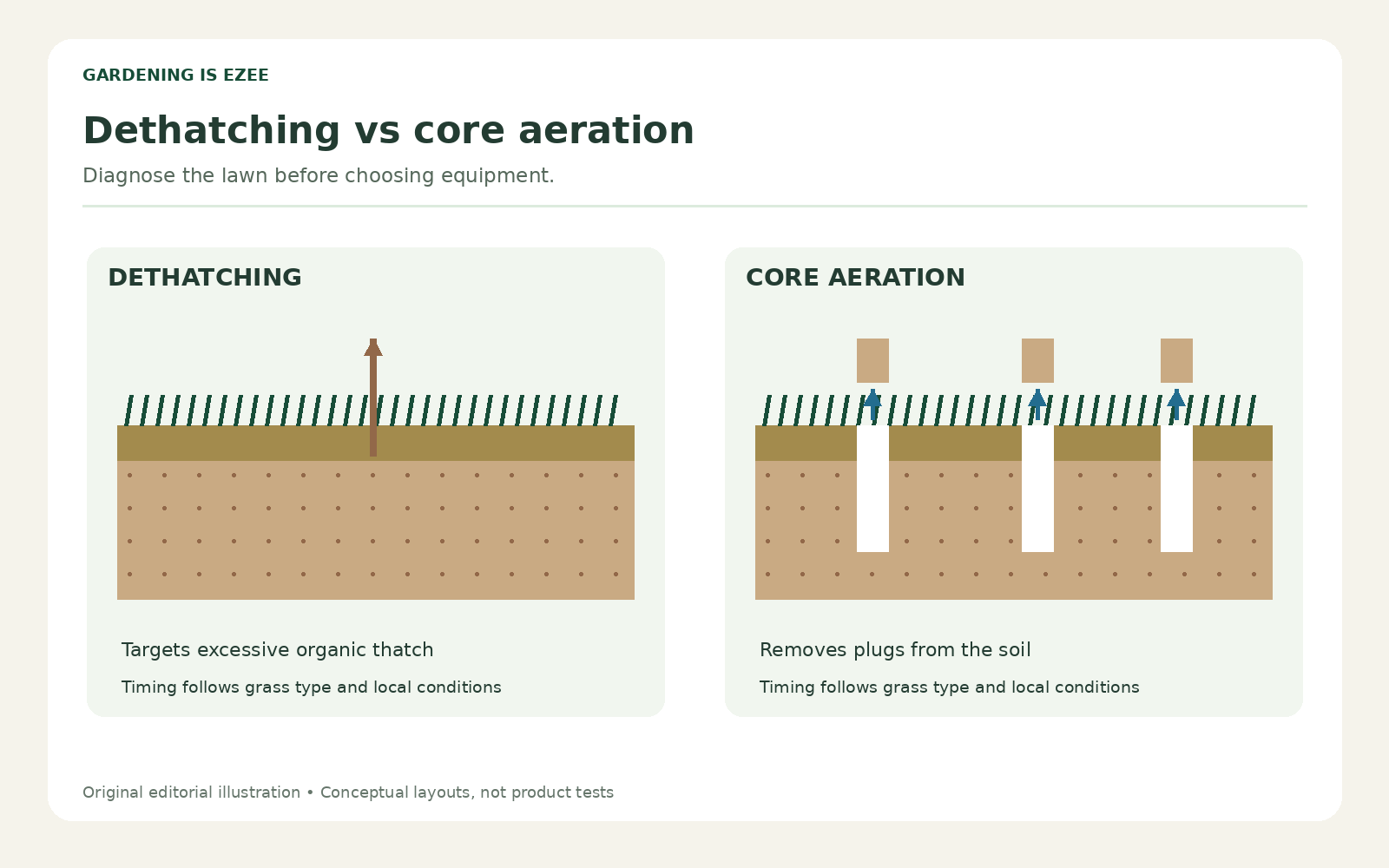
Illustration: Gardening Is Ezee. Dethatching and core aeration act on different parts of the lawn profile.
What thatch actually is
Thatch is an interwoven layer of living and dead plant tissue above the mineral soil and below the green vegetation. It is not simply loose leaves sitting on top of the lawn. A small amount is not automatically a problem; an excessive layer can interfere with the lawn's growing conditions.
Do not assume normal grass clippings are the main cause. Penn State Extension's turfgrass guidance distinguishes clippings from the roots, crowns, and other tissues associated with thatch accumulation. Removing every clipping is not a substitute for diagnosing the layer.
Inspect a small section of the lawn profile with a suitable hand tool. Look for the distinct fibrous layer between soil and vegetation. Compare more than one location because an old sunny area and a shaded newer patch may behave differently.
What soil compaction means for the decision
Compaction concerns the soil's physical condition. Repeated traffic, especially under unsuitable moisture conditions, can contribute. A heavily used route across the lawn may show a different pattern from an area that rarely receives foot traffic.
Look at location and history. Does the thin area follow a shortcut, a play area, or a place where machinery repeatedly traveled? Is there a compacted construction layer or poor drainage? Those observations guide the next check rather than establishing the answer by themselves.
A lawn can be compacted without a thick thatch layer, and it can have thatch without severe compaction. Keeping the two concepts separate prevents choosing a dethatcher when the main issue lies below the surface or hiring an aerator without examining the organic layer.
How dethatching works

A lawn scarifier or dethatcher uses a different working action from a core aerator. Photo: Stehfun, CC BY 2.5 via Wikimedia Commons.


A plug aerator removes soil cores rather than only pressing solid spikes into the lawn. Photo: Agri-Fab, Inc., CC0 via Wikimedia Commons.

Dethatching equipment uses a design intended to pull or cut through the thatch layer. Products may use spring tines, vertically oriented blades, or interchangeable assemblies. The terminology in consumer listings is not always consistent, so inspect what the machine actually does.
The goal is to remove excessive material with an appropriate degree of disturbance. The amount removed depends on the layer, grass, equipment, and settings. A large pile of debris is not automatically proof that the treatment was necessary or correctly performed.
Read the machine manual and grass-specific guidance before operating. A setting intended for one task may be too aggressive for another lawn. Do a small test area where appropriate and check the result before treating the whole property.
How core aeration works
A core aerator uses hollow tines to remove plugs. That differs from merely pressing solid spikes into the ground. The distinction matters when shopping, because products labeled aerator can perform different actions.
Penn State Extension's seasonal lawn management guide specifically distinguishes core equipment from solid-tine or spike equipment. If your objective is to alleviate compaction through core removal, verify that the service or machine does that job.
Actual penetration depends on the equipment and soil conditions. A pass across hard dry ground may not produce the intended cores. More passes are not a sensible automatic response if the equipment cannot operate effectively under the current conditions.
A quick comparison
| Question | Dethatching | Core aeration |
|---|---|---|
| Main target | Excessive thatch layer | Compacted soil conditions |
| Typical action | Pulling or cutting organic material | Removing soil plugs |
| Evidence to gather | Lawn profile and thatch thickness | Traffic pattern, soil condition, drainage observations |
| Common confusion | Mistaking loose clippings for thatch | Mistaking spike holes for core removal |
| Key timing issue | Grass must be able to recover | Grass must be able to recover |
| What it cannot guarantee | Fixing shade, disease, or unsuitable grass | Fixing every drainage or fertility problem |
Use the comparison to choose an investigation, not to prescribe work from one symptom. If the evidence is unclear, a local extension service or qualified turf professional can help identify the issue before you rent or buy equipment.
Inspect the lawn in several places
Choose representative locations: a healthy section, a thin section, a traffic area, and a place where water behaves differently. Examine the profile and note the conditions. Photograph the samples with a scale if you want to compare them later.
Measure the thatch layer separately from total sod thickness. Soil adhering to roots is not all thatch. Do not combine loose surface debris with the interwoven layer just to reach a threshold quoted online.
For compaction, compare soil condition and site history rather than relying on a single screwdriver test. Penetration resistance changes with moisture and soil texture. A dry patch can feel hard for reasons that require further evaluation.
Thresholds depend on the grass and guidance
Different extension references use different action thresholds and contexts. University of Georgia's home lawn guide discusses thatch thicker than half an inch, while Penn State's cool-season guidance discusses greater accumulation in its regional context. Those should not be flattened into one universal number.
Identify your grass species and region, then use the appropriate recommendation. The same machine treatment can affect grasses with different growth habits differently. A mixed lawn may need more careful planning than a single uniform turf type.
The most useful takeaway is to measure and consult the right guidance rather than dethatching annually because a calendar says so. Routine inspection can be annual even when aggressive material removal is not.
Timing for cool-season lawns
Cool-season grasses should be treated when local conditions favor active growth and recovery. In many regions that means an appropriate late-summer or early-fall window, but local weather and grass condition matter. A national month-by-month rule can be misleading.
Avoid aggressive work during drought stress, extreme heat, dormancy, or when insufficient recovery time remains before adverse weather. Consider whether you can provide the follow-up care required. A rental available today is not a good reason to work on stressed turf.
University of Maryland Extension's established lawn guidance connects these operations with active growth and lawn type. Use that principle together with a local calendar for your grass rather than copying a Minnesota date into a different climate.
Timing for warm-season lawns
Warm-season grasses need their own recovery window during suitable active growth. Do not apply a cool-season autumn plan automatically. Species, regional climate, and the lawn's condition determine the appropriate timing.
University of Georgia Extension's soil and aeration guidance emphasizes active root growth. Local warm-season calendars can make that principle more specific, but their recommendations remain tied to their region.
If you do not know the grass, identify it before aggressive work. A mixed patch with different seasonal behavior may need targeted treatment or a broader renovation plan. Guessing the species can lead to an operation at the wrong point in its growth cycle.
Soil moisture affects core removal
The soil needs suitable moisture for effective core removal. Very dry soil can resist penetration; overly wet conditions can create their own damage and handling problems. Follow local turf guidance and the equipment instructions.
Evaluate the soil, not only the surface appearance. A recent light rain may dampen leaves while leaving the working zone dry. Conversely, the surface may look ready while deeper soil remains excessively wet.
If conditions are unsuitable, postpone or adjust preparation through documented guidance. Do not keep making passes simply because the machine is rented. Effective work requires the right combination of machine, conditions, and a lawn able to recover.
Mark what equipment must avoid
Identify irrigation heads, shallow lines, edging, roots, stones, drains, and other obstacles before operating. Follow applicable requirements for locating utilities if the work could affect them. Do not assume all buried systems lie below the machine's working depth.
Mark obstacles visibly and review the route before starting. A hose lying in grass is easy to overlook, particularly when the operation produces debris. Move portable items and keep access paths clear.
Penn State's lawn establishment guidance highlights irrigation heads and other obstacles during renovation planning. Even a small lawn benefits from the same simple preparation: know what is there before a powered machine moves through it.
Do you need both operations?
A lawn with excessive thatch and compaction may justify both within a planned renovation. That does not mean everyone should bundle the two services automatically. Each operation should have a reason and a recovery plan.
Sequence depends on the overall work, grass, equipment, and local recommendations. If overseeding, amendments, or other renovation steps are included, use an integrated plan instead of stacking unrelated internet instructions.
Ask a contractor to explain the diagnosis, equipment, sequence, and aftercare. A useful proposal identifies the problem being addressed. An offer to dethatch and aerate every lawn regardless of condition is not a substitute for inspection.
After dethatching: plan for cleanup and recovery
Removed material needs to be collected as directed by the treatment plan. Decide where it will go before operating. A large pile left on the lawn can interfere with the intended result and make follow-up care difficult.
Inspect the treated area. Look for damage, remaining excessive material, and places needing separate attention. Do not immediately repeat an aggressive pass just because the lawn looks thin after disturbance. The appropriate next step may be recovery rather than more removal.
Follow species- and site-specific guidance for watering, mowing, and any seeding or nutrient application. Do not apply fertilizer automatically without considering a soil test, existing program, and local requirements. Mechanical work does not make every nutrient addition necessary.
After aeration: understand the plugs
Core aeration commonly leaves plugs at the surface. Follow the recommended treatment plan for those plugs rather than assuming they must all be removed. Their appearance can surprise homeowners who expected a clean-looking lawn immediately after the service.
Review whether seeding or topdressing is part of the plan. Those choices should have a separate purpose and appropriate timing. A topdressing product is not automatically suitable merely because holes have been made in the soil.
Avoid heavy use while the lawn recovers according to the guidance for the work performed. Photograph the same areas later so you can evaluate improvement over time. The next morning's appearance is not the only measure of success.
Buying a dethatcher versus renting or hiring
A small electric unit may suit a manageable lawn and a specific thatch task. Check working width, cord requirements, attachments, depth adjustment, collection method, and replacement parts. Do not assume a machine called scarifier performs every lawn renovation operation.
For occasional work, rental or professional service may be more sensible than ownership. Include transport, storage, maintenance, and physical handling in the comparison. A heavy core aerator can involve a very different task from pushing a compact dethatcher.
Use Gardening Is Ezee's electric dethatcher guide and Greenworks dethatcher comparisons after confirming the lawn needs that operation. Selecting a machine before diagnosis reverses the useful order.
Three lawn examples
Thin grass on a shortcut to the shed
The damaged strip follows repeated foot traffic. Inspect soil condition and the lawn profile. If compaction is a confirmed issue, core aeration may be relevant, but the traffic pattern also needs a solution.
A path or changed route can prevent repeated damage more effectively than treating the same strip each year. If shade or drainage also contributes, address those conditions. A machine can help with part of the problem without resolving the whole site.
A springy lawn with a measured organic layer
The profile shows a substantial fibrous layer above soil. Identify the grass and compare the measurement with relevant guidance. Dethatching may be appropriate if the layer is excessive and conditions allow recovery.
Review the long-term lawn program too. Mowing, nutrient management, and grass growth habits can affect recurrence. Removing material without considering why it accumulated can turn a corrective treatment into a repeated expense.
A brown lawn during drought
Do not interpret brown color as evidence that immediate dethatching or aeration is needed. Identify whether the grass is dormant, stressed, diseased, or affected by another condition. Aggressive work during stress can make recovery harder.
Use a suitable local diagnosis and wait for appropriate conditions if mechanical treatment is later justified. The desire to do something quickly should not replace evidence about what the lawn actually needs.
Questions to ask a lawn service
Ask what grass they identified, what measurements support the recommended operation, and what equipment will be used. For aeration, confirm whether it removes cores. For dethatching, ask how the settings and method fit the grass.
Ask about timing, obstacle marking, weather contingencies, debris handling, and aftercare. Clarify whether seeding or fertilization is included and why. A quote should make the resulting work understandable, not simply list attractive lawn-care terms.
Keep your own photographs and observations. They help evaluate the work and compare recovery. The goal is a healthier, more manageable lawn over the relevant growing period, not just visible holes or a large pile of removed material.
Frequently asked questions
Should I dethatch every year?
Not automatically. Inspect the thatch layer and use grass-specific guidance. Some lawns need little or no aggressive removal. Annual assessment is different from annual treatment, and unnecessary disturbance can create avoidable recovery work.
Are spike shoes the same as core aeration?
No. Core aeration removes plugs using hollow tines. Products that press spikes into the soil perform a different action. If a recommendation calls for core removal, verify that the equipment or service provides it.
Can aeration remove thatch?
Core aeration can contribute to thatch management, but it should not be assumed to replace every thatch-removal need. Evaluate the layer, compaction, and overall plan. A severe problem may require a different or combined approach through appropriate guidance.
Which operation helps poor drainage?
It depends on the cause. Compaction may be part of the issue, but grading, unsuitable soil layers, runoff, and other site conditions can also matter. Neither operation guarantees drainage correction. Diagnose the site rather than choosing from the symptom alone.
Distinguish a maintenance task from a renovation project
A lawn needing a targeted correction is different from a lawn needing broad renovation. If most of the area is thin, unsuitable for the site, or affected by several conditions, a machine-only treatment may be an incomplete plan. Examine the cause and the desired result before purchasing equipment.
A renovation plan might involve grass selection, drainage assessment, traffic changes, soil testing, seeding, and follow-up care. Dethatching or aeration can be part of that plan, but neither should become the explanation for every poor lawn. The sequence should serve the diagnosis rather than the availability of a rental machine.
Define success in observable terms. You may want better growth in a traffic strip, less excessive thatch, or a more suitable seedbed. Take photographs and notes before the work. A clear objective lets you evaluate recovery without expecting the whole lawn to transform immediately.
If the diagnosis is uncertain, gather more information before aggressive treatment. A local extension consultation can be less expensive than buying a machine for the wrong problem. Describe grass type, site history, irrigation, recent care, and symptom pattern. Those details make advice more specific than a close-up of one brown patch.
Evaluate a machine listing beyond its name
Consumer terms such as dethatcher, scarifier, power rake, and aerator can overlap in marketing. Read the attachment description, working action, adjustment range, and intended task. A removable spring-tine assembly is different from a blade assembly, and neither is automatically a hollow-tine core aerator.
Check whether the machine's instructions address your grass and intended operation. Working depth settings are model-specific. Do not copy a setting number from a video showing another product. The same number can describe a different distance or action on a different machine.
For an electric unit, read power-supply and extension-cord requirements. For a rental or service machine, ask about transport, operator demands, and access width. A product can suit the lawn area while being difficult to move through a gate or store safely.
Collection capacity is another practical point. A small bag may need frequent emptying during a heavy removal task. Plan the disposal route and follow the operating instructions before restarting after each stop. A large advertised working width does not describe the time spent collecting material.
Ask about replacement tines, blades, belts, or other user-serviceable parts where relevant. A tool used infrequently can still need maintenance. Ownership only makes sense if you can store and maintain the equipment and if its actual job is one your lawn needs.
Review recovery before planning repeat treatment
After the work, compare the treated areas over the appropriate growing period. Keep the same photo positions and note weather, watering, traffic, and any follow-up actions. Those observations help explain improvement or continuing problems without attributing everything to the machine.
Do not schedule another aggressive treatment solely because the lawn has not changed immediately. Recovery takes suitable conditions and care. If damage is unexpected or worsening, seek an appropriate diagnosis rather than repeating the operation.
Review prevention as well as repair. Can you redirect foot traffic? Does the mowing routine suit the grass? Is fertilizer being used according to need? Is the site too shaded for the turf you want? A useful maintenance plan reduces the reason for repeated corrective work.
For a service contract, ask whether future treatment is based on inspection or automatically included every year. The useful arrangement keeps diagnosis in the loop. Paying for an unnecessary operation is not good value even when it is part of a discounted package.
Finally, keep machinery recommendations separate from product promotion. A buyer's guide can help choose a tool once the lawn needs that task. It should not persuade you to create a task merely because the tool is available. Evidence about the lawn should lead the purchase decision.
Keep a lawn inspection note for the next season
A short record can prevent unnecessary repeat work. Note the grass identification, locations inspected, measured thatch layer where relevant, traffic pattern, treatment performed, and recovery conditions. Add photographs from fixed positions. This gives the next assessment a reference instead of relying on memory that the lawn looked better or worse.
Separate the treatment from other changes. If you aerated, changed watering, redirected foot traffic, and overseeded, improvement cannot automatically be credited to aeration alone. That does not make the plan ineffective; it means the result belongs to the combined work. Preserve that distinction when deciding what to repeat.
Record areas that did not respond. Persistent thinning may need another diagnosis involving shade, drainage, grass suitability, pests, or other factors. Repeating the same machine treatment without reviewing those areas can turn uncertainty into an annual expense.
Before the next season, inspect again rather than copying last year's service order. Some conditions may recur, while others may have been corrected. The record should support a fresh decision. Its purpose is to help you choose necessary work and appropriate timing, not to lock the lawn into a permanent treatment schedule.
Sources and further reading
- Penn State Extension: Managing Thatch in Lawns.
- Penn State Extension: Lawn Management Through the Seasons.
- Penn State Extension: Lawn Establishment.
- Penn State Extension: Cool-Season Turfgrass.
- University of Maryland Extension: Maintaining an Established Lawn.
- University of Georgia Extension: Ten Steps to a Healthier Home Lawn.
- University of Georgia Extension: Turfgrass Soil, Aeration, and pH.
Editorial method: This is an original decision guide supported by regional turf references. Timing and treatment thresholds must be matched to the grass and location. No equipment testing or site diagnosis is claimed.