
Buying Guide
40V vs 80V Lawn Mowers: A Practical Garden Guide
40V vs 80V lawn mowers compared by watt-hours, deck width, runtime, weight, recharge workflow, and ecosystem cost so you buy the platform that matches your.
By Gardening Is Ezee Editors
10 min read5 products evaluated
A higher voltage number is not automatically a stronger or longer-running mower. Voltage only describes electrical pressure; it says nothing about how much energy a pack actually stores.
What actually predicts runtime and cutting power is watt-hours, which you get by multiplying nominal volts by amp-hours. A 40V mower with a large amp-hour pack can outlast an 80V mower with a small one. We compared real 40V and 80V mowers on included watt-hours, deck width, weight, self-propel draw, and recharge workflow so you can match the platform to your lawn instead of the label on the deck.
Gardening Is Ezee field notes
The Garden Fit Check
A quick way to connect the shortlist to the space, workload and ownership details that matter after the box arrives.
- Start with the job
- Greenworks 80V 21-Inch Self-Propelled Mower leads this shortlist for medium lawns where self-propel and higher included watt-hours matter more than upfront cost. Use that fit as a reference point, then compare the alternatives against your own space and workload.
- Specs that separate the picks
- The first details to compare are 21-inch deck, 16-inch deck. Confirm the exact model and included components before ordering.
- Trade-off to plan for
- Heavier than comparable 40V push mowers
The Practical Shortlist
A garden-first look at 5 options, organized around the job each one suits best.

Best Overall (80V)
Greenworks 80V 21-Inch Self-Propelled Mower
medium lawns where self-propel and higher included watt-hours matter more than upfront cost
Our take Check price for Greenworks 80V 21-Inch Self-Propelled Mower (opens in a new tab)
Best Overall (40V)
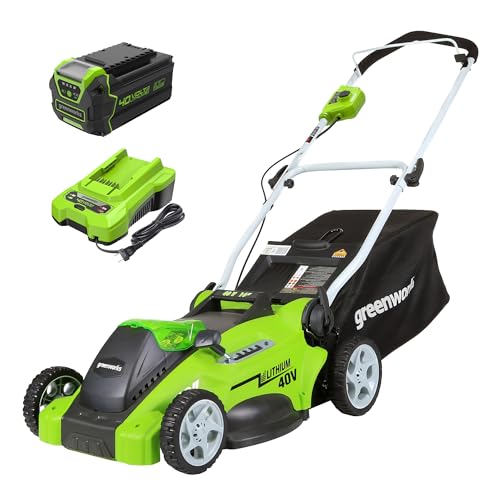
Greenworks 40V 16-Inch Push Mower
small to mid-size lawns and buyers already invested in a 40V tool platform
Our take Check price for Greenworks 40V 16-Inch Push Mower (opens in a new tab)

Widest 40V Deck
Worx WG752 40V 21-Inch 3-in-1 Mower
buyers who want a full-width deck without moving to an 80V ecosystem
Our take Check price for Worx WG752 40V 21-Inch 3-in-1 Mower (opens in a new tab)

Also Consider (80V)
Greenworks 80V 21-Inch Push Mower
flat lawns where higher included watt-hours matter more than self-propel
Our take Check price for Greenworks 80V 21-Inch Push Mower (opens in a new tab)

Widest Deck (80V)
Greenworks 80V 25-Inch Self-Propelled Mower
larger open lawns where deck width matters more than maximizing runtime per charge
Our take Check price for Greenworks 80V 25-Inch Self-Propelled Mower (opens in a new tab)
Why Each Pick Made the Cut
Best Overall (80V)1 of 5
Greenworks 80V 21-Inch Self-Propelled Mower on Amazon (opens in a new tab)
The strongest case for Greenworks 80V 21-Inch Self-Propelled Mower is 320Wh nominal energy from the included 4.0Ah pack.
Best for
- medium lawns where self-propel and higher included watt-hours matter more than upfront cost
Why it made the shortlist
For medium lawns where self-propel and higher included watt-hours matter more than upfront cost, this is one of the more relevant configurations in the shortlist. The documented setup centers on 21-inch deck, 80V 4.0Ah battery, 320Wh nominal energy.
Its case starts with 320Wh nominal energy from the included 4.0Ah pack. Its 80V 4.0Ah battery specification sits at the upper end of the comparable range in this 5-product comparison. Treat the battery platform and included charger as part of the fit, not just the headline number.
The trade-off worth checking first is heavier than comparable 40V push mowers. Confirm whether the battery and charger are included with the exact package. Check platform compatibility and published runtime against the area or workload you need to cover.
Key dimensions & specs
- 21-inch deck
- 80V 4.0Ah battery
- 320Wh nominal energy
- Self-propelled drive
Pros
- 320Wh nominal energy from the included 4.0Ah pack
- Self-propelled drive reduces pushing effort
Cons
- Heavier than comparable 40V push mowers
Best Overall (40V)2 of 5
Greenworks 40V 16-Inch Push Mower on Amazon (opens in a new tab)
Choose Greenworks 40V 16-Inch Push Mower for 160Wh included energy from the 4.0Ah pack.
Best for
- small to mid-size lawns and buyers already invested in a 40V tool platform
Why it made the shortlist
Greenworks 40V 16-Inch Push Mower is positioned for small to mid-size lawns and buyers already invested in a 40V tool platform. The documented setup centers on 16-inch deck, 40V 4.0Ah battery, 160Wh included energy.
The feature doing most of the work here is 160Wh included energy from the 4.0Ah pack. Its 40V 4.0Ah battery specification sits at the lower end of the comparable range in this 5-product comparison. Treat the battery platform and included charger as part of the fit, not just the headline number.
The practical constraint here is narrower 16-inch deck means more passes on larger lawns. Confirm whether the battery and charger are included with the exact package. Check platform compatibility and published runtime against the area or workload you need to cover.
Key dimensions & specs
- 16-inch deck
- 40V 4.0Ah battery
- 160Wh included energy
- Push drive
Pros
- 160Wh included energy from the 4.0Ah pack
- Lighter deck and battery for easier pushing and storage
Cons
- Narrower 16-inch deck means more passes on larger lawns
- No self-propel option on this model
Widest 40V Deck3 of 5
Worx WG752 40V 21-Inch 3-in-1 Mower on Amazon (opens in a new tab)
Worx WG752 40V 21-Inch 3-in-1 Mower makes the shortlist because 21-inch deck matches the width of the 80V options here.
Best for
- buyers who want a full-width deck without moving to an 80V ecosystem
Why it made the shortlist
This model is aimed at buyers who want a full-width deck without moving to an 80V ecosystem. The documented setup centers on 21-inch deck, 40V battery platform, 3-in-1 mulch, bag, side discharge.
The most useful documented advantage is 21-inch deck matches the width of the 80V options here. Its 40V battery platform specification sits at the lower end of the comparable range in this 5-product comparison. Treat the battery platform and included charger as part of the fit, not just the headline number.
Confirm whether the battery and charger are included with the exact package. Check platform compatibility and published runtime against the area or workload you need to cover.
Key dimensions & specs
- 21-inch deck
- 40V battery platform
- 3-in-1 mulch, bag, side discharge
- Push drive
Pros
- 21-inch deck matches the width of the 80V options here
- 3-in-1 mulch, bag, and side discharge in one mower
Also Consider (80V)4 of 5
Greenworks 80V 21-Inch Push Mower on Amazon (opens in a new tab)
Choose Greenworks 80V 21-Inch Push Mower for same 320Wh nominal energy as the self-propelled 80V model.
Best for
- flat lawns where higher included watt-hours matter more than self-propel
Why it made the shortlist
Greenworks 80V 21-Inch Push Mower is positioned for flat lawns where higher included watt-hours matter more than self-propel. The documented setup centers on 21-inch deck, 80V 4.0Ah battery, 320Wh nominal energy.
The feature doing most of the work here is same 320Wh nominal energy as the self-propelled 80V model. Its 80V 4.0Ah battery specification sits at the upper end of the comparable range in this 5-product comparison. Treat the battery platform and included charger as part of the fit, not just the headline number.
The practical constraint here is no self-propel, so pushing effort is entirely manual. Confirm whether the battery and charger are included with the exact package. Check platform compatibility and published runtime against the area or workload you need to cover.
Key dimensions & specs
- 21-inch deck
- 80V 4.0Ah battery
- 320Wh nominal energy
- Push drive, no self-propel
Pros
- Same 320Wh nominal energy as the self-propelled 80V model
- No drive motor draw, so more energy reaches the blade
Cons
- No self-propel, so pushing effort is entirely manual
Widest Deck (80V)5 of 5
Greenworks 80V 25-Inch Self-Propelled Mower on Amazon (opens in a new tab)
The strongest case for Greenworks 80V 25-Inch Self-Propelled Mower is 25-inch deck covers more ground per pass than the 21-inch 80V options.
Best for
- larger open lawns where deck width matters more than maximizing runtime per charge
Why it made the shortlist
For larger open lawns where deck width matters more than maximizing runtime per charge, this is one of the more relevant configurations in the shortlist. The documented setup centers on 25-inch deck, 80V 4.0Ah battery, 320Wh nominal energy.
Its case starts with 25-inch deck covers more ground per pass than the 21-inch 80V options. Its 80V 4.0Ah battery specification sits at the upper end of the comparable range in this 5-product comparison. Treat the battery platform and included charger as part of the fit, not just the headline number.
The trade-off worth checking first is same included watt-hours spread across a wider deck plus drive load means shorter sessions per charge. Confirm whether the battery and charger are included with the exact package. Check platform compatibility and published runtime against the area or workload you need to cover.
Key dimensions & specs
- 25-inch deck
- 80V 4.0Ah battery
- 320Wh nominal energy
- Self-propelled drive
Pros
- 25-inch deck covers more ground per pass than the 21-inch 80V options
- Self-propelled drive on a wider deck
- Same 80V ecosystem as the narrower Greenworks models above
Cons
- Same included watt-hours spread across a wider deck plus drive load means shorter sessions per charge
How We Built This Shortlist
Each pick was assessed across 4 criteria weighted for real-world use.
- Included watt-hours over voltage label
- We compared capacity, compatibility, included components, operating limits and warranty documentation.
- Deck width against energy budget
- We compared each mower's deck width to its included watt-hours to judge whether the energy budget was proportional to the cutting width and drive load it has to support.
- Weight, storage, and recharge workflow
- We considered mower weight, folding and storage footprint, full recharge time, and whether a second pack or charger was a realistic option for each platform.
- Ecosystem and ownership cost
- We factored in replacement battery and charger cost, and whether the platform overlaps with other yard tools a buyer might already own on the same voltage system.
What Matters Before You Choose
Key buying criteria so you get the right fit the first time.
Compare matched watt-hours, not the voltage label
A 40V mower with a larger pack can store more energy than an 80V mower with a small one, so put both mowers' watt-hours side by side before deciding voltage settles anything.
This is the kind of detail that looks minor at a glance but shapes how satisfied you actually are with the purchase once you've lived with it for a few weeks, since it plays out differently in daily use than it does on paper.
Compare deck width and grass load at the same energy level
A wider deck and thicker or taller grass both draw down a battery faster. Before comparing two mowers across voltage classes, check that you are comparing similar deck widths and similar grass conditions, otherwise the comparison is really about deck size, not voltage.
This is the kind of detail that looks minor at a glance but shapes how satisfied you actually are with the purchase once you've lived with it for a few weeks, since it plays out differently in daily use than it does on paper.
Map out the runtime, cut, weight, and recharge workflow together
Runtime per charge, cutting width, mower weight, and how long a depleted pack takes to recharge all interact. A heavier 80V deck with a long runtime may still cost you more total mowing time if the pack needs hours to recharge before the second half of a large lawn.
This is the kind of detail that looks minor at a glance but shapes how satisfied you actually are with the purchase once you've lived with it for a few weeks, since it plays out differently in daily use than it does on paper.
Weigh ecosystem breadth at equal cost
If you already own trimmers, blowers, or other tools on a 40V or 80V platform from the same brand, a shared battery and charger across tools can be worth more than a marginal watt-hour advantage on the mower alone.
Weigh ecosystem breadth at equal cost is easy to overlook next to flashier specs, but it's frequently the difference between a 40V or 80V lawn mower that fits your routine and one that quietly becomes a hassle.
Verify the complete configuration
80V platforms more often support wider decks and self-propel without straining runtime, which suits larger or thicker lawns where deck width and drive assistance matter more than upfront cost.
This is the kind of detail that looks minor at a glance but shapes how satisfied you actually are with the purchase once you've lived with it for a few weeks, since it plays out differently in daily use than it does on paper.
Match the Tool to the Job
Match the Scenario to a Named Pick
| Buyer scenario | Recommended pick |
|---|---|
| Small to mid-size lawn, budget-conscious, own other 40V tools | Greenworks 40V 16-Inch Push Mower |
| Full-width deck without moving to 80V | Worx WG752 40V 21-Inch 3-in-1 Mower |
| Medium lawn, want self-propel and higher included watt-hours | Greenworks 80V 21-Inch Self-Propelled Mower |
| Flat lawn, want 80V capacity without paying for self-propel | Greenworks 80V 21-Inch Push Mower |
| Larger open lawn where deck width outweighs runtime per charge | Greenworks 80V 25-Inch Self-Propelled Mower |
40V and 80V Side by Side
- 40V platform
- Confirm dimensions, compatibility and included components for your setup.
- 80V platform
- More often paired with wider decks and self-propel drive without straining runtime, since the higher voltage supports moving more current to both the blade motor and a drive motor at once. Packs, chargers, and replacement batteries typically cost more.
Real Ownership Checklist
| Item | Verify before buying |
|---|---|
| Included energy | Compared using published specifications, included components, compatibility, and practical trade-offs. |
| Deck and drive load | Deck width and whether self-propel draws from the same pack as the blade |
| Recharge workflow | Full charge time, and whether a second pack is available and worth the extra cost |
| Ecosystem fit | Whether the platform's batteries and chargers overlap with other yard tools you own or plan to buy |
Before You Bring One Home
Is an 80V mower always more powerful than a 40V mower?
Not automatically. Voltage describes electrical pressure, not stored energy. A 40V mower with a large amp-hour battery can store more watt-hours than an 80V mower with a small pack, so compare watt-hours directly rather than assuming a higher voltage number wins.
How do I calculate watt-hours from the spec sheet?
For example, a 40V battery rated at 4.0Ah stores approximately 160 watt-hours, while an 80V battery rated at 4.0Ah stores approximately 320 watt-hours.
Does a wider deck need more watt-hours to cover the same lawn?
Generally yes. A wider deck cuts more grass per pass, which increases power draw, and self-propel drive adds further load if it shares the same battery as the blade. Compare deck width against included watt-hours together rather than looking at either spec in isolation.
What should I verify before ordering?
In this comparison, yes, the 40V packs and chargers were generally lower cost to replace or add as spares than the 80V equivalents. If you already own tools on one of these platforms, matching the mower to that ecosystem can reduce long-term battery and charger cost.
When does it make sense to choose 80V over 40V?
Choose 80V when you want a wider deck, self-propel drive, or longer runtime under heavier grass load without the pack running down quickly, and when the higher battery and charger cost is acceptable. Choose 40V when the lawn is small to mid-size, you want a lighter mower, or you already own other 40V tools on the same battery platform.
Bottom Line
Best overall: Greenworks 80V 21-Inch Self-Propelled Mower — best overall (80v) pick in this roundup. See the full verdicts above for every pick, with pros, cons and who each one suits.
Browse all 40v vs 80v lawn mowers on Amazon — Prime-eligible options with current pricing.