
Practical Garden Guide
Why Is My Compost Tumbler Not Heating Up?
A cool tumbler is not automatically broken; diagnose batch size, moisture, material balance and stage before changing several things at once.
By Gardening Is Ezee EditorsUpdated 16 min read
A compost tumbler may stay cool because the batch is small, the ingredients are too dry or too wet, the mixture lacks suitable fresh material, air movement is poor, or the batch has already moved past its active stage. It may also be decomposing slowly without a substantial hot phase. Before adding a compost starter or buying another tumbler, identify which situation you have.
Heat is a useful observation, but it is not the only sign of progress. Look at changing texture, volume, odor, and how much of the original material remains recognizable. A cool, gradually changing mixture calls for a different response from a wet, compacted batch that smells unpleasant and has barely changed.
This guide uses a step-by-step diagnosis. It does not promise that every small household tumbler can sustain hot composting, and it does not treat a single temperature reading as proof that the material has been sanitized.
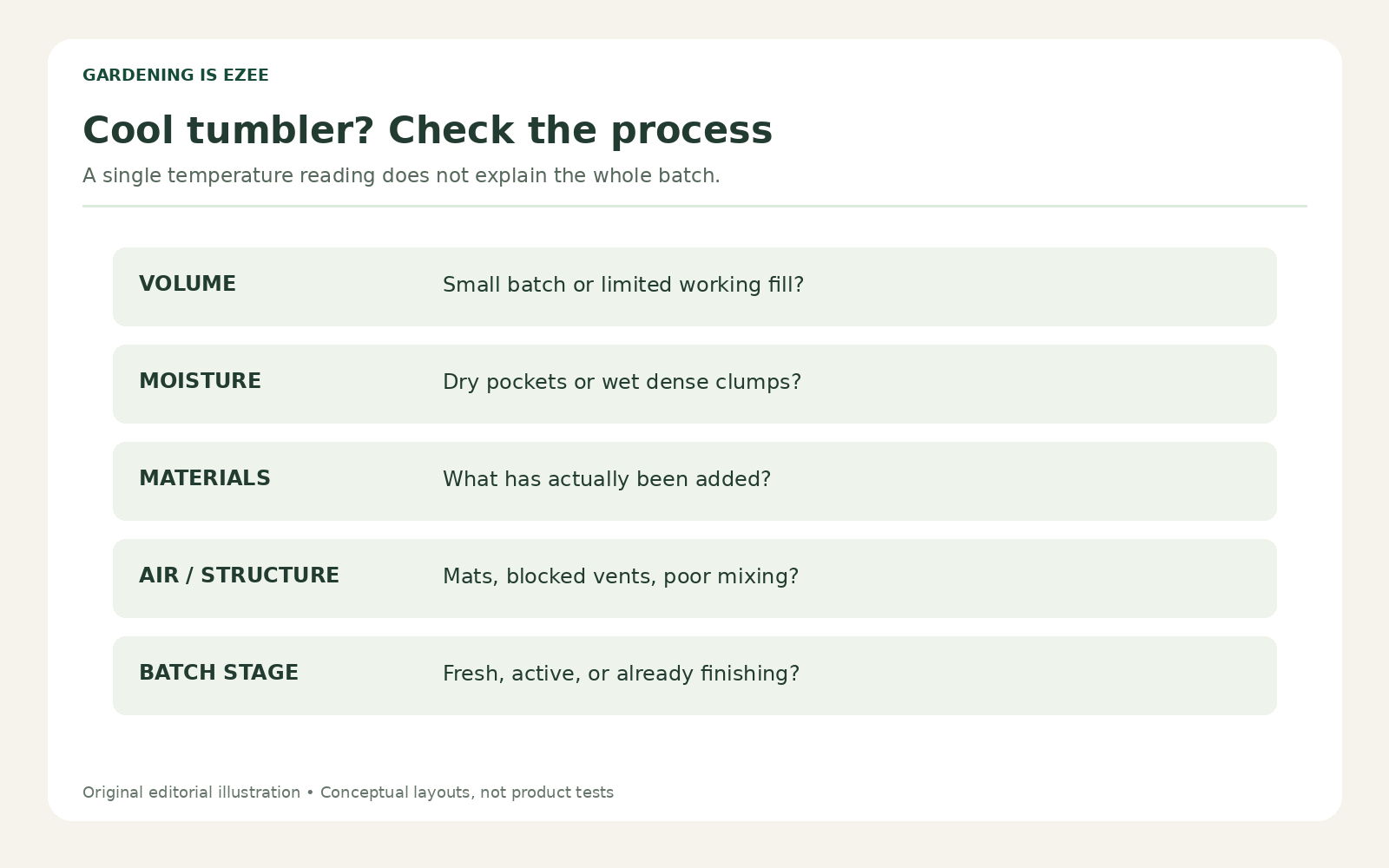
Illustration: Gardening Is Ezee. Diagnose the mixture before adding products or changing the container.
First ask whether the batch should be hot

Measuring conditions inside compost provides better evidence than touching the container shell. Photo: SuSanA Secretariat, CC BY 2.0 via Wikimedia Commons.

A small daily supply of scraps may not create the same conditions as a substantial batch assembled at once. Continually adding a little fresh material also mixes stages: yesterday's scraps sit beside older material. The whole chamber may not behave like a single active batch.
Consider the age of the contents. A batch that previously warmed and is now cooling may be progressing normally. A nearly finished batch does not need more raw scraps simply to make the thermometer rise again. Adding those scraps starts new decomposition and complicates readiness.
University of Wisconsin Extension's compost guide explains the importance of pile size for heat retention. A small tumbler has different geometry and volume, so do not transfer a large-pile expectation to it without considering those limits.
Measure the material, not the sun-warmed shell
The outside of a dark tumbler can warm in sunshine even when the contents are not generating substantial heat. A shell temperature is therefore not a reliable substitute for a measurement inside the batch. Use a suitable compost thermometer according to its instructions.
Take measurements in a consistent location and at comparable times. If the chamber is shallow, be careful not to measure against the wall or outside the material. Record the ambient conditions and whether you recently rotated or added ingredients.
A sequence of observations is more informative than one reading. Note changes over several days rather than opening the chamber repeatedly in search of a target number. If the instrument's probe cannot reach the material appropriately, choose a suitable measurement method instead of interpreting a questionable reading.
Make a simple diagnosis sheet
| Observation | Possible explanation | Next useful check |
|---|---|---|
| Small amount of material | Limited heat retention or slowly accumulated batch | Compare with the tumbler's working capacity |
| Dry leaves remain crisp | Insufficient moisture or poor contact | Check moisture inside the mixture |
| Wet, dense clumps and odor | Excess wet inputs or poor structure | Inspect air spaces and material balance |
| Mostly dry woody material | Slowly decomposing ingredients | Review particle size and available fresh inputs |
| Previously hot, now crumbly and earthy | Later stage of decomposition | Assess readiness and curing needs |
| Shell warm, center unchanged | Solar warming | Measure the actual material consistently |
Treat the table as a way to organize investigation, not as a definitive diagnosis from a single symptom. Several issues can occur together. Correct the obvious physical problem first and record what you changed.
Check batch volume and usable capacity
Look at how much material is actually present in the chamber. The product's total advertised volume may be divided between two chambers, and the working fill may be less than the maximum. Follow the manual's fill guidance and leave the room needed for mixing.
Do not fill a tumbler beyond its working limit merely to chase heat. An overloaded chamber can become difficult to rotate and may mix poorly. Capacity is a constraint to respect, not a target to exceed whenever compost seems slow.
If your waste stream is too small for an active batch, consider a slower method or a different system. The goal is useful decomposition and manageable waste handling. Producing heat is only valuable when it supports the process you intend to run.
Check moisture inside several parts of the batch
The top and bottom of the chamber may not feel the same. Inspect a small sample from more than one location using suitable gloves and tools. Look for dry pockets, wet clumps, and liquid accumulation rather than judging the whole load from the first handful near the door.
If the mixture is dry, add moisture gradually and mix as the method requires. Do not pour in a large amount because the surface looks dusty. Dry material can wet unevenly, so recheck after mixing before adding more.
If the mixture is wet and dense, pause wet additions and use appropriate dry, structured material to improve the mix. Illinois Extension's compost troubleshooting page links odor with insufficient air and provides a useful starting diagnosis. Manage the physical conditions rather than masking the smell.
Review what you have been adding
Write down the recent inputs. A stream dominated by fruit scraps is different from one dominated by dry leaves. Coffee grounds look brown but are commonly grouped with nitrogen-rich inputs in composting guidance. The everyday color names are not a chemical test.
Do not confuse a carbon-to-nitrogen ratio with a bucket ratio of browns to greens. The first describes material composition; the second is a practical mixing rule using volumes. Different ingredients have different moisture and composition, so a simple volume rule is only a starting point.
Use an accepted-material list and a reliable composting method. Avoid adding meat, pet waste, unknown treated plant material, or commercial-only compostable packaging to a basic home tumbler. A hoped-for hot phase does not make unsuitable inputs safe or manageable.
Break up mats and oversized pieces
Inspect whether the contents move as a loose mixture or tumble as a few large masses. Wet grass, compressed leaves, and soft scraps can form dense clumps. Rotating the chamber may move those clumps without mixing their interiors effectively.
Break up manageable mats with an appropriate tool when the unit is stationary and safe to access. Reduce very large plant pieces as appropriate before adding them. Do not introduce hands or tools while another person can rotate the chamber.
A varied, workable structure matters more than making every ingredient extremely fine. Powdery or dense material can create its own handling problems. The aim is a mixture that allows air and moisture to reach the decomposing material, not a uniformly ground paste.
Rotation should help mixing, not replace inspection
Follow the tumbler manufacturer's instructions for rotation and working fill. Frequent spinning is not a cure for every problem. If the mixture is too wet or the chamber is overloaded, more rotation may simply roll the same clumps around.
Observe what happens after mixing. Does the material redistribute, or remain stuck to the wall? Can you see dry pockets becoming incorporated? Those observations help decide whether the next action should be moisture adjustment, structural material, or reduced loading.
Avoid setting a universal number of rotations for all products. Handle design, chamber shape, baffles, and load differ. Use the manual and the mixture's behavior. A routine should improve the batch, not become a ritual performed without checking the result.
Airflow and drainage openings
Check the accessible vents and any designed drainage arrangement without modifying the product. A vent blocked by material or debris can interfere with the intended operation. Clean user-serviceable parts using the manufacturer's method.
Do not drill extra holes as an automatic solution. That can change drainage, pest resistance, structural integrity, and warranty conditions. If the product's airflow seems inadequate, contact the manufacturer with photographs and a description of the load.
Liquid draining from a tumbler is not automatically a suitable plant fertilizer. It can come from incompletely decomposed material, and its composition is unknown. Manage excess moisture and follow appropriate disposal guidance rather than giving the liquid a beneficial name and pouring it onto edible crops.
Cold weather changes expectations
Ambient cold can slow the process and increase heat loss from a small chamber. That does not mean the same recipe that worked in summer will produce the same temperature in winter. Compare observations with the season and local conditions.
Avoid improvised electrical heaters, flames, or unapproved modifications. Moving a composter also requires care: consider weight, stability, clearance, and whether the new location is appropriate. Do not bring an outdoor compost tumbler indoors simply to increase warmth without evaluating hygiene and suitability.
If your setup is seasonal, accept a slower winter period and plan capacity accordingly. A separate collection or composting destination can prevent overfilling. The right winter response may be a changed workflow rather than an attempt to force a small batch to behave like a large hot pile.
Do you need a compost starter?
A starter is not the first diagnostic step. Check material mix, moisture, volume, structure, and airflow before spending money. A purchased additive does not correct an overloaded chamber or turn a dry pile into a properly moistened mixture.
Iowa State Extension's composting questions notes that inoculants or activators are not generally necessary for a compost pile. Evaluate any product claim against the problem you have actually identified.
If a manufacturer requires a particular additive for a specialized system, follow that documented process. Ordinary backyard composting advice and a proprietary processing system are not automatically interchangeable. Identify the method before assuming a bag labeled accelerator is essential.
A seven-observation recovery plan
Start by recording batch age and the last fresh addition. Measure the actual material temperature appropriately. Estimate working volume. Check moisture in more than one location. Review inputs. Inspect structure and accessible vents. Then decide which correction is justified.
Make a measured change and record it. For example, if the mixture is dry throughout, add water gradually and mix before reevaluating. If it is wet and dense, pause wet scraps and improve the mixture with suitable dry structured material. Do not make opposite adjustments on successive days without checking conditions.
Observe progress over a reasonable interval. Look for changes in temperature, texture, odor, and volume. The exact timing depends on conditions. A recovery plan should provide evidence that the mixture is improving, not promise a finished batch by a fixed date.
Three common situations
A half-empty chamber receiving small daily scraps
The load has no clear batch start, and volume accumulates slowly. It may decompose without a strong hot phase. First decide whether you want to manage a batch or accept a slower continuous process.
If managing a batch, designate a suitable place for new inputs while the older material finishes. Do not solve the problem by overfilling or adding inappropriate waste. Consider whether a different-sized system better matches the household's input stream.
A chamber full of soggy kitchen scraps
The issue is not simply lack of heat. The mixture may be poorly structured and excessively wet. Stop adding more wet material while assessing it. Review acceptable dry ingredients and the product's loading limit.
Mix carefully, correct conditions through a reliable method, and inspect afterward. Adding a starter to the same soggy mass may leave the underlying problem unchanged. The useful purchase might be dry-material storage rather than another composter.
A batch that warmed, shrank, and then cooled
This can indicate progression rather than failure. Look for remaining recognizable food scraps, texture, odor, and the need for a finishing period. Do not add fresh material solely to recreate the earlier temperature peak.
Keep the finishing batch separate from new scraps. Evaluate readiness for the intended use, particularly around seedlings or sensitive plants. A compost thermometer is an observation tool; it does not certify nutrient balance or eliminate the need to assess the material.
Know what heat cannot prove
A hot center does not demonstrate that every part of the batch experienced adequate conditions for the required time. Material beside the walls or in a dense clump may behave differently. One reading should not be used to claim reliable sanitization.
If your objective includes pathogen reduction or destruction of difficult weed seeds, ordinary home-tumbler management may not provide the necessary documented process. Use appropriate inputs and seek specialized guidance rather than relying on a vague hot-compost claim.
The EPA's compostable-plastics guidance also distinguishes commercial composting conditions from ordinary home systems. Packaging labeled compostable does not automatically belong in your tumbler.
Track progress without making compost a full-time job
Use a brief note once or twice during a consistent observation interval rather than checking constantly. Record what you added, any adjustment, the temperature method, and the mixture's condition. A photograph can make texture changes easier to compare.
Label chambers if you use a dual design. The label should identify loading and finishing, not simply left and right. Include the date when fresh additions stopped. This prevents another household member from restarting the finishing batch unknowingly.
Keep a practical supply of accepted dry material beside the system. A routine that includes both scraps and companion materials is easier to sustain than one that requires searching the yard every time the kitchen bucket fills.
When a different system makes sense
Consider changing systems if the current capacity does not match your inputs, loaded rotation is difficult, or harvesting is awkward. Those are practical fit problems. They can justify a different product even when the composting process itself is sound.
If the only concern is that the thermometer never reaches an advertised number, first decide whether a hot method is necessary. A slower system may still meet your waste-reduction and garden goals. The right outcome is usable, appropriately managed material, not a temperature competition.
Read Compost Tumbler vs Compost Bin before replacing the container. For model comparisons, see FCMP compost tumblers. Choose capacity and access based on your workflow, not on an unverified speed promise.
Frequently asked questions
Is cool compost useless?
No. A slower process can still produce useful compost. Assess the material's condition and allow the finishing process appropriate to the method. Cool material with fresh scraps is not the same as mature compost, so readiness still needs evaluation.
Should I add more greens?
Only if the diagnosis supports that adjustment. A dry, carbon-heavy mixture is different from a wet chamber already full of food scraps. Check moisture and inputs before adding anything. More fresh scraps can worsen a wet, poorly structured load.
Should I rotate every day?
Use the product instructions and observe whether mixing helps. Daily rotation is not a universal requirement or cure. An overloaded chamber, wet mats, or a finishing batch needs an appropriate response rather than a fixed spinning routine.
Will sunlight make hot compost?
Sun can warm the container, but that is not the same as microbial heat within the batch. Measure the material appropriately and consider the full process. A warm shell alone does not show decomposition progress or sanitation.
When should I stop troubleshooting for heat?
Stop chasing heat when the system is intentionally operating slowly or the batch has moved into finishing. Continue observing material condition and readiness. If the setup never fits your input volume or access needs, reconsider the system rather than endlessly adding products.
Separate a process problem from a product problem
The container can have a real defect, but many disappointing results come from the batch or routine. Check whether the chamber closes, rotates, drains, and ventilates as designed. Then assess the material separately. A broken handle is a product problem; a chamber containing almost only wet scraps is primarily a process problem.
Describe the issue precisely before contacting the seller. The chamber is overloaded and difficult to turn is different from the axle binding under a permitted working load. The door leaks because its seal is damaged is different from liquid draining through a designed opening. Clear observations help you obtain relevant support.
Keep photographs of the normal working fill and any defective part. Use the product manual to determine whether the setup is within its intended conditions. Do not modify the container while a warranty or service question remains unresolved. An improvised repair can complicate both diagnosis and support.
If the container functions correctly, return to the batch diagnosis rather than searching for a more powerful model. Composters do not have a performance upgrade that removes the need for appropriate materials, moisture, and management. A larger system may solve a capacity mismatch, but it does not automatically solve an unsuitable input routine.
Read the batch history before making another adjustment
Write the last few weeks as a short timeline. When did you start loading? What materials dominated? When did fresh additions stop? Did the batch warm previously? When did you last add water or dry material? Those questions can explain why a cool chamber is not necessarily stalled.
A temperature decline after a period of activity has a different meaning from a load that never changed. Likewise, cooling immediately after opening and mixing does not establish failure. The sequence matters. Use the history alongside current texture, moisture, odor, and recognizable ingredients.
Avoid alternating between water and dry additions because you are chasing a number. If you added water yesterday, inspect its effect before adding more today. If you corrected a wet mixture with dry structured material, allow the correction to be evaluated. Repeated opposite adjustments can obscure the original issue and waste useful ingredients.
Keep the observations proportionate to the goal. If you are managing household scraps through a slower method, a detailed hot-phase log may not be necessary. If you are trying to document a particular process, more careful monitoring is required. Do not claim the stricter result from the looser routine.
Make the next batch easier to manage
Once the present batch is understood, change the collection routine to prevent the same issue. Keep suitable dry material within reach, reduce oversized plant pieces appropriately, and separate finishing material from new additions. These are often more useful improvements than purchasing an additive.
Choose a clear batch boundary if that fits the system. Mark the date when fresh loading stops and identify the alternative destination for new scraps. A finishing chamber needs protection from accidental additions by other household members. Labels are a practical process tool, not decoration.
Review the chamber's working capacity before the next seasonal peak. If a vegetable-bed cleanup will exceed it, plan another appropriate route for those materials. Do not compact everything into the tumbler merely because that is the container you own. Seasonal capacity should be planned, not discovered after the door will barely close.
Set expectations from the method and conditions. A warm-season batch and a small winter load may behave differently. A household producing a few scraps each day may need patience rather than a fast-batch promise. The useful measure is whether the process remains manageable and produces appropriately finished material for the intended use.
When the system works, preserve the routine rather than the exact ingredient count. Materials vary. Record the mixture's workable condition, convenient loading pattern, and useful observations. That gives you a flexible reference for the next batch without pretending that composting follows a fixed kitchen recipe.
Decide what improvement you are looking for
Before changing the batch, write the intended improvement in plain language. You may want the mixture to be less wet, the material to mix more evenly, or the process to progress without odor. Those are observable goals. Simply demanding a higher temperature can lead to adjustments that ignore the actual problem.
Choose one useful observation for each change. After moisture correction, inspect whether dry pockets remain. After improving structure, check whether the contents still move as dense clumps. After separating finishing material, confirm that new scraps stay out. This makes troubleshooting practical rather than a sequence of purchases.
If the batch progresses through a slower method, update your expectations instead of treating every cool reading as failure. Keep readiness and intended use in focus. Material that is still recognizable or unsuitable for the intended application needs further management, regardless of its past temperature.
Use the outcome to improve the next routine. A convenient dry-material supply, a clear batch label, and an appropriate capacity plan are repeatable benefits. A temporary temperature rise without a manageable process is much less useful to the household over the whole season.
Sources and further reading
- Wisconsin Horticulture: Making and Using Compost.
- Illinois Extension: Troubleshooting Composting Problems.
- Illinois Extension: Questions About Composting.
- Iowa State Extension: Soil, Fertilizing, and Composting FAQs.
- US EPA: Plastic Recycling and Composting FAQs.
- Oregon State University Extension: Troubleshoot Compost Heat, Odor, and Pests.
Editorial method: This is an original diagnostic guide supported by linked composting references. It does not report a product trial, guarantee a hot phase, or certify homemade compost as sanitized.