
Buying Guide
Our Guide to the Best Solar Animal Repellers Under $50
Six solar animal repellers under $50 compared on sensor reach, sensitivity levels, ultrasonic range and an 8-pack of predator-eye lights for coops.
By Gardening Is Ezee Editors
11 min read6 products evaluated
Spend up to $50 and the choice is no longer whether to try a solar repeller but which signal to bet on. Some run ultrasound with a flash, one uses red predator-eye lights that need no sound at all, and they differ in how far the sensor reaches and how finely you can tune it.
The group holds the Peepst with a 39 ft sensor and two operating modes, the YOHHOS with five sensitivity levels, the RQQN with the widest stated frequency span, a JahyElec two-pack, a Broox that adds an alarm and an eight-pack of nocturnal predator-eye lights for chicken coops and fence lines.
Results depend on the animal and on whether anything tempting is nearby. Pair any of these with cleaned-up food sources and give it a few weeks before judging.
Gardening Is Ezee field notes
The Garden Fit Check
A quick way to connect the shortlist to the space, workload and ownership details that matter after the box arrives.
- Start with the job
- Peepst Solar Ultrasonic Repeller with Dual Modes leads this shortlist for a larger yard needing reach. Use that fit as a reference point, then compare the alternatives against your own space and workload.
- Specs that separate the picks
- The first details to compare are 120 degree, 39 ft sensor, 5 sensitivity levels, IP66, UV protected. Confirm the exact model and included components before ordering.
- Trade-off to plan for
- 10 to 14 kHz is a narrow frequency band
The Practical Shortlist
A garden-first look at 6 options, organized around the job each one suits best.

Best Overall
Peepst Solar Ultrasonic Repeller with Dual Modes
a larger yard needing reach
Our take Check price for Peepst Solar Ultrasonic Repeller with Dual Modes (opens in a new tab)

Best Tunable Sensitivity
YOHHOS Solar Ultrasonic Repeller with 5 Sensitivity Levels
spots with false triggers
Our take Check price for YOHHOS Solar Ultrasonic Repeller with 5 Sensitivity Levels (opens in a new tab)

Best Weather Rating
RQQN Solar Ultrasonic Animal Repeller
exposed spots in wet climates
Our take Check price for RQQN Solar Ultrasonic Animal Repeller (opens in a new tab)

Best Two-Pack
JahyElec Sonic Fortress Pro 2 Pack
a yard with two entrances
Our take Check price for JahyElec Sonic Fortress Pro 2 Pack (opens in a new tab)
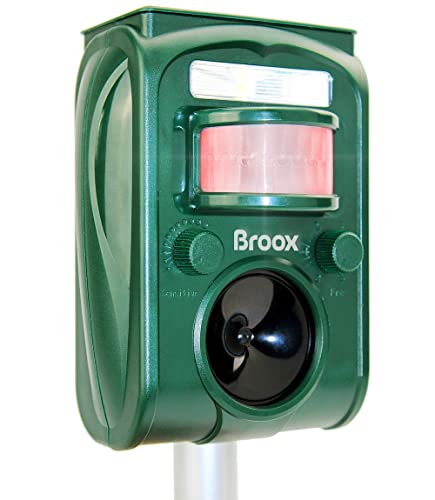
Best with Alarm
Broox Solar Ultrasonic Repeller with Alarm
remote spots where an alarm helps
Our take Check price for Broox Solar Ultrasonic Repeller with Alarm (opens in a new tab)

Best for Coops
Lycxbfjia 8 Pack Solar Predator Eyes Repeller
chicken coops and night-time perimeters
Our take Check price for Lycxbfjia 8 Pack Solar Predator Eyes Repeller (opens in a new tab)
Why Each Pick Made the Cut
Best Overall1 of 6
Peepst Solar Ultrasonic Repeller with Dual Modes on Amazon (opens in a new tab)
The longest reach in the group: a 120 degree sensor out to 39 ft, with continuous or motion-triggered modes.
Best for
- a larger yard needing reach
Our take
A solar repeller with a 120 degree PIR sensor covering 39 ft, which activates ultrasonic waves at 10 to 14 kHz and bright flashing lights. Two modes, continuous deterrence or motion-triggered, adapt it to different yards, and an IP44 ABS housing handles rain and snow. It goes on a ground stake or a wall, and the height adjusts to the animal.
The sensor reach is the widest of the six, so one unit watches more ground than the 33 ft YOHHOS or JahyElec. The 10 to 14 kHz band is narrow compared with the RQQN and Broox, which can matter if animals adapt. It is a single unit, where the JahyElec gives two.
Buy it for a larger yard where reach matters. Skip it if you need two units, and take the JahyElec.
Key dimensions & specs
- 120 degree, 39 ft sensor
- 10 to 14 kHz output
- Continuous or motion mode
Pros
- 120 degree sensor reaches 39 feet, the widest here
- Continuous mode suits a spot with constant traffic
- Height adjusts to match the animal you target
- Stake or wall mount both work
Cons
- 10 to 14 kHz is a narrow frequency band
- Single unit and IP44 weather sealing only
Best Tunable Sensitivity2 of 6
YOHHOS Solar Ultrasonic Repeller with 5 Sensitivity Levels on Amazon (opens in a new tab)
The fine-tuner: five sensitivity levels, 13.5 to 45 kHz of ultrasound and a flame-style flashing light.
Best for
- spots with false triggers
Our take
A solar repeller that emits 13.5 to 45 kHz ultrasound with a flame-style flashing light when its infrared sensor detects movement within 110 degrees and 33 ft. Five sensitivity levels let you decide how easily it triggers, and modes combine different frequencies and light patterns. It charges in sun for two days first, or from a cord indoors, and pushes into soil.
Adjustable sensitivity stops it firing at every leaf or passing car, which saves battery and avoids false alarms. The sensor reach of 33 ft is shorter than the Peepst's 39 ft. The RQQN has a wider frequency span for similar money.
Buy it for a spot with wind or traffic that triggers false alarms. Skip it if you want maximum reach, and take the Peepst.
Key dimensions & specs
- 5 sensitivity levels
- 13.5 to 45 kHz
- 110 degree, 33 ft sensor
Pros
- Five sensitivity levels cut down false triggers
- 13.5 to 45 kHz range varies the sound
- Flame-style flashing light adds a visual deterrent
- Charge by sun or a cord indoors
Cons
- 33 foot reach is shorter than the Peepst
- First charge needs two full days of sun
Best Weather Rating3 of 6
RQQN Solar Ultrasonic Animal Repeller on Amazon (opens in a new tab)
The weatherproof pick: IP66 and UV-protected housing with ultrasound spanning 13.5 to 65.5 kHz.
Best for
- exposed spots in wet climates
Our take
A solar repeller with an IP66 waterproof housing, UV-protected construction and ultrasound from 13.5 to 65.5 kHz, the widest stated span here. It sets up in about a minute: aim it at the area, select a mode and place it. The listing claims it works on dogs, raccoons and birds among other animals.
IP66 is the highest weather rating in the group, which matters in a wet climate or on an exposed fence. The listing gives no sensor angle or range, which the Peepst and YOHHOS do, so you cannot compare reach. It is a single unit.
Buy it for a wet or sunny exposed spot. Skip it if sensor range matters to you, and take the Peepst.
Key dimensions & specs
- IP66, UV protected
- 13.5 to 65.5 kHz
- Single solar unit
Pros
- IP66 housing handles heavy rain and spray
- UV protection resists sun damage over seasons
- 13.5 to 65.5 kHz is the widest span here
- Sets up in about a minute with no tools
Cons
- No sensor angle or range is published
- Single unit covers one approach route
Best Two-Pack4 of 6
JahyElec Sonic Fortress Pro 2 Pack on Amazon (opens in a new tab)
Two IP65 units with a 33 ft sensor each: the pick when you need more than one spot covered.
Best for
- a yard with two entrances
Our take
Each of the two units reads motion across a 110 degree arc, reaching 33 ft, then fires ultrasound with flashing LEDs. The sealed IP65 body has a top-mounted solar panel and either stakes into soil or hangs from a fence by its rear slot. The listing names deer, cats, dogs, squirrels, raccoons, rabbits, skunks and foxes.
Where the Peepst reaches farther with one unit, this gives two sensors for a similar price, so you can cover a gate and a garden bed. The listing publishes no frequency range, which the RQQN and YOHHOS do. IP65 is above the IP44 of the Peepst.
Buy it for a yard with two entrances. Skip it if you want a stated frequency range, and take the YOHHOS.
Key dimensions & specs
- 2 units, 110 degree sensor
- 33 ft range, IP65
- Stake or wall mount
Pros
- Two sensors cover a gate and a garden bed
- IP65 housing is a step above IP44 units
- Targets a long list from deer to foxes
- Ground stake or fence slot gives placement choices
Cons
- No ultrasonic frequency range is published
- 33 foot reach is shorter than the Peepst
Best with Alarm5 of 6
Broox Solar Ultrasonic Repeller with Alarm on Amazon (opens in a new tab)
A single unit that adds an audible alarm to ultrasound and LED flashing, with 13.5 to 45.5 kHz of output.
Best for
- remote spots where an alarm helps
Our take
A solar repeller that outputs ultrasonic sound from 13.5 to 45.5 kHz, an alarm and a flashing LED when its motion detector triggers. It can be charged by solar or another route, inserts into the ground or mounts on a wall, and offers mode selection. The listing aims it at cats, squirrels and deer.
The audible alarm sets it apart: the other units are silent to people, but this one is not, so it can startle animals ultrasound alone misses and may bother neighbors. It costs the most in the group for a single unit, and gives no IP rating or sensor range. The JahyElec offers two units for much less.
Buy it for a spot far from houses where a loud alarm helps. Skip it near neighbors, and take the YOHHOS.
Key dimensions & specs
- 13.5 to 45.5 kHz
- Alarm plus LED flash
- Ground or wall mount
Pros
- Audible alarm startles animals ultrasound may miss
- 13.5 to 45.5 kHz range with mode selection
- Ground stake or wall mount placement
- Humane, with no chemicals or traps involved
Cons
- Alarm can bother people and neighbors
- Costs the most for a single unit
Best for Coops6 of 6
Lycxbfjia 8 Pack Solar Predator Eyes Repeller on Amazon (opens in a new tab)
Eight solar red-light units that look like watchful eyes after dark, for coops, fence lines and trash areas.
Best for
- chicken coops and night-time perimeters
Our take
An eight-pack of solar nocturnal deterrents, each with two red flashing LEDs arranged like a pair of eyes. They charge in direct sun and switch on automatically at night, and the IP65 housing sits on exposed fences or posts. The listing suggests placing them around chicken coops, fence openings and trash areas.
This is a visual deterrent, not ultrasound: it targets nocturnal predators like coyotes, and it needs no sound. Eight units means every approach route gets one. It does nothing in daytime, and animals can get used to lights, so move them every couple of weeks.
Buy it to ring a coop or garden perimeter at night. Skip it for daytime pests like deer, and take the Peepst.
Key dimensions & specs
- 8 units, red LED eyes
- Auto on at dusk
- IP65 housing
Pros
- Eight units cover every approach to a coop
- Switches on automatically at dusk, no daily setup
- IP65 housing handles rain on an exposed fence
- No sound, so it will not bother neighbors
Cons
- Works only after dark, not against daytime pests
- Animals can adapt to a fixed light pattern
How We Built This Shortlist
Each pick was assessed across 5 criteria weighted for real-world use.
- Sensor reach
- Angle and range in feet were compared, since a repeller only works inside its sensor zone.
- Frequency and signal variety
- Published kHz span, modes and sensitivity levels were weighed against habituation.
- Day versus night coverage
- Ultrasonic units and red predator-eye lights were scored for the time of day they cover.
- Weather resistance
- IP ratings and UV protection decided which units suit an exposed fence.
- Units per dollar
- Pack size was divided into price to compare coverage per unit.
What Matters Before You Choose a Solar Animal Repeller
Key buying criteria so you get the right fit the first time.
Sensor angle and reach
Reach decides how much ground one unit watches: 39 ft at 120 degrees is more than 33 ft at 110 degrees. Aim along the animal route rather than across open lawn. Check the angle and range in feet, and remember that sound weakens with distance.
Ultrasonic frequency range
A wide span such as 13.5 to 65.5 kHz gives the device more variety than a narrow 10 to 14 kHz band. Varying frequency is the main tool against habituation. Look for a published kHz range, and note that some listings give none.
Sensitivity and false triggers
Wind, leaves and cars can set off a motion sensor, draining the battery and annoying neighbors. Sensitivity levels let you reduce that. Check for adjustable sensitivity if your yard is busy.
Visual versus ultrasonic deterrent
Ultrasound reaches animals within the sensor range at any time, while red predator-eye lights work only after dark and target nocturnal predators. Combining the two covers more. Decide whether your problem is day or night.
Weather rating and sun
IP44 shrugs off rain, IP65 and IP66 handle driving rain and spray, which matters on an open fence. The panel needs direct sun and a first charge of one to two days. Check the IP rating and place the unit where it sees sun.
Habituation and placement
Animals tend to ignore a fixed signal after a week or two, so move the unit or change the mode every couple of weeks. Keep it away from bird feeders and nests, since ultrasound may distress birds. Plan on a rotation routine.
Match a Solar Animal Repeller to Your Garden or Yard
By Yard Layout
| Your yard | Recommended pick | Why |
|---|---|---|
| Large open yard | Peepst Solar Ultrasonic Repeller with Dual Modes | 39 ft sensor reach |
| Busy, windy yard | YOHHOS Solar Ultrasonic Repeller with 5 Sensitivity Levels | Tunable triggers |
| Exposed wet fence | RQQN Solar Ultrasonic Animal Repeller | IP66, UV protected |
| Gate plus garden bed | JahyElec Sonic Fortress Pro 2 Pack | Two units, IP65 |
| Remote field edge | Broox Solar Ultrasonic Repeller with Alarm | Adds audible alarm |
| Chicken coop perimeter | Lycxbfjia 8 Pack Solar Predator Eyes Repeller | Eight night lights |
Scroll sideways to see every column.
By Budget
| Price range | Recommended pick | What you get |
|---|---|---|
| $17 to $19 | Peepst Solar Ultrasonic Repeller with Dual Modes | 120 degree, 39 ft |
| $17 to $19 | YOHHOS Solar Ultrasonic Repeller with 5 Sensitivity Levels | Five sensitivity levels |
| $24 to $25 | RQQN Solar Ultrasonic Animal Repeller | IP66, 13.5 to 65.5 kHz |
| $29 to $30 | JahyElec Sonic Fortress Pro 2 Pack | Two IP65 units |
| $39 to $40 | Lycxbfjia 8 Pack Solar Predator Eyes Repeller | Eight night units |
| $49 to $50 | Broox Solar Ultrasonic Repeller with Alarm | Ultrasound plus alarm |
Scroll sideways to see every column.
Ultrasonic Units vs Predator-Eye Lights
- Ultrasonic units
- Sound and a flashing light triggered by motion work day and night within sensor range, but animals can adapt. In this comparison: Peepst, YOHHOS, RQQN, JahyElec and Broox.
- Predator-eye lights
- Red flashing LEDs resemble eyes after dark and need no sound, aimed at nocturnal predators near coops. They do nothing by day. In this comparison: Lycxbfjia.
Most gardens should default to an ultrasonic unit, unless coyotes or night raiders around a coop are the problem.
By Signal You Want
| Signal preference | Recommended pick | Why |
|---|---|---|
| Widest frequency span | RQQN Solar Ultrasonic Animal Repeller | 13.5 to 65.5 kHz |
| Fewest false triggers | YOHHOS Solar Ultrasonic Repeller with 5 Sensitivity Levels | Five sensitivity levels |
| Always-on in a hotspot | Peepst Solar Ultrasonic Repeller with Dual Modes | Continuous mode |
| Sound plus loud alarm | Broox Solar Ultrasonic Repeller with Alarm | Adds audible alarm |
| Silent after dark | Lycxbfjia 8 Pack Solar Predator Eyes Repeller | Red light only |
| Standard sound and light | JahyElec Sonic Fortress Pro 2 Pack | Ultrasound plus LED |
Scroll sideways to see every column.
For Protecting a Chicken Coop Specifically
- Look for
- Night coverage on every approach route, a weather rating for an exposed fence, and a signal aimed at nocturnal predators rather than daytime pests.
- In this comparison
- The Lycxbfjia 8 Pack Solar Predator Eyes Repeller puts a light on each route at dusk. For daytime visitors, add the Peepst Solar Ultrasonic Repeller with Dual Modes on the main path.
When to Spend More
- Spend more if
- You need several units or a unique signal. The Lycxbfjia 8 Pack Solar Predator Eyes Repeller covers a whole perimeter, and the Broox Solar Ultrasonic Repeller with Alarm adds an audible alarm.
- Save if
- One unit will cover your problem spot. The Peepst Solar Ultrasonic Repeller with Dual Modes and the YOHHOS Solar Ultrasonic Repeller with 5 Sensitivity Levels cost the least.
Before You Bring One Home
Do solar repellers work on deer?
Results are mixed. Ultrasound tends to be better against cats and small mammals, and deer can adapt quickly. Use a repeller as one layer and vary the signal.
How far apart should I place units?
Place each along an animal route, within its sensor range of about 30 to 39 ft. Overlapping units cover a larger area, and a two-pack lets you do that cheaply.
Why does my repeller keep triggering?
Wind, moving branches and cars can set off a PIR sensor. Lower the sensitivity if the unit has levels, like the YOHHOS, and aim it away from busy roads.
Do predator-eye lights really work?
They help against some nocturnal animals but only after dark, and animals can adapt. Move them around every couple of weeks and combine with food control.
How long does the solar charge last?
Units need direct sun to charge and run at night from the battery. The first charge takes one to two days. In a cloudy climate, expect gaps, so place the panel where it gets the most sun.
Will ultrasound harm birds or pets?
It can bother dogs and cats within range, and may distress birds, so keep the unit away from feeders and nests and test with your pets nearby.
Bottom Line
Best overall: Peepst Solar Ultrasonic Repeller with Dual Modes — best overall pick in this roundup. See the full verdicts above for every pick, with pros, cons and who each one suits.
Browse all solar animal repellers under $50 (2026) on Amazon — Prime-eligible options with current pricing.